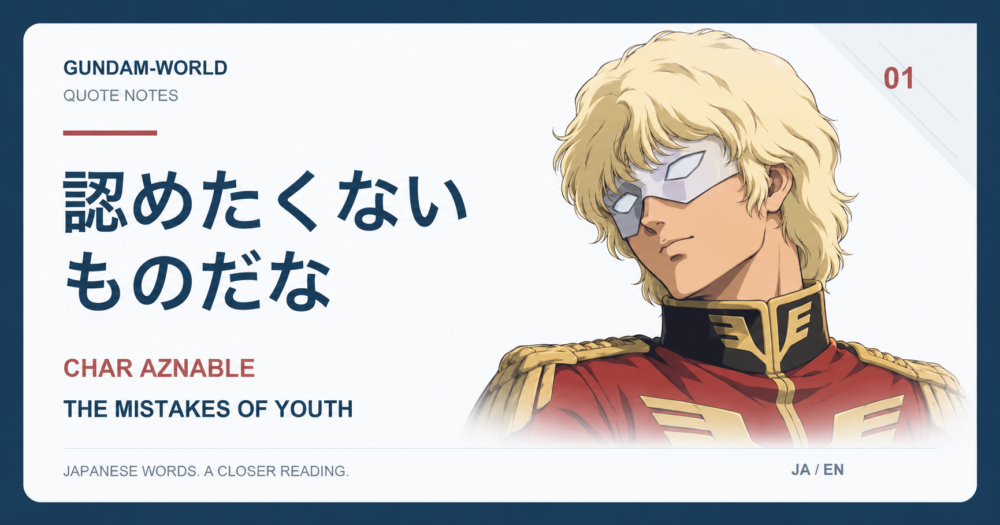
Char Aznable’s “mistakes of youth” line means that he does not want to acknowledge errors connected with his own youth. It appears in episode 1 of the original Mobile Suit Gundam television series. The important tension is between recognizing a mistake and resisting that recognition: Char sounds composed, yet the sentence exposes his pride.
This essay discusses the opening episode. The English renderings below are our translations for explaining the Japanese, rather than quotations from a licensed subtitle or dub.
The Japanese line and its episode
認めたくないものだな。自分自身の、若さゆえの過ちというものを
Mobile Suit Gundam; Japanese dialogue
Our translation: I would rather not admit it—the mistakes that come from my own youth.
STRICT-G’s official Famous Lines product page identifies the speaker as Char and places the dialogue in TV episode 1, whose Japanese title is ガンダム大地に立つ!!. This is the original television story; a later manga retelling should not be used to silently change its scene or wording.
What does “mitometakunai mono da na” mean?
Mitomeru means to recognize or acknowledge something. Here, mitometakunai expresses not wanting to do that. It is a statement of resistance, rather than an inability to understand what happened. Translating it simply as “I was wrong” would remove the feature that makes the line so revealing.
The ending mono da na gives the thought a reflective, almost generalized shape. Char can sound as though he is contemplating a familiar human weakness, even while the words concern himself. Our reading is that this distance lets him preserve his poise: he can name the problem without making the blunt confession that an ordinary apology would require.
Wakasa yue no connects the errors with youth: roughly, “arising from youth” or “because of being young.” Ayamachi is an error or misstep; choosing “sin” in English would add a stronger moral judgment than the wording alone requires. Nothing in this sentence guarantees that every youthful failure is forgivable.
Whose mistake is Char talking about?
The words jibun jishin, “oneself” or “one’s own self,” make self-reference central to a straightforward reading. An explanation that makes the line only an insult aimed at somebody else loses that uncomfortable inward turn. A capable officer can recognize his own involvement while still speaking in a way that protects his self-image.
That does not settle every argument about exactly which judgment Char regrets. The line does not enumerate a complete chain of command decisions or provide a private confession of motive. Distinguishing what the sentence says from what we infer about him makes the character more interesting, because his controlled presentation leaves room for doubt.
Why English versions can feel different
A more compact alternative rendering of our own would be: “It is hard to own up to the errors of youth.” This sounds like an observation about people in general. Our first rendering keeps “my own” and the speaker’s reluctance more visible. The difference shows why a smooth translation can shift the balance between personal confession and universal wisdom.
Neither rendering is presented as the one official English line. Subtitles, dubs, books and licensed merchandise are separate publications. A comparison needs to identify the particular edition before treating its wording as evidence. For readers learning Japanese, the useful question is which part of Char’s voice an English choice brings forward.
Char and Full Frontal: two ways of discussing mistakes
Our Full Frontal essay offers a useful contrast. Read side by side, Char’s line draws attention to the difficulty of acknowledging a personal error, while Full Frontal’s discussion of mistakes invites questions about adulthood and authority. This is a thematic comparison, not a claim that the two scenes have identical purposes.
Quick questions
Which Gundam episode contains this Char quote?
Episode 1 of the original Mobile Suit Gundam television series. The official product reference above gives the Japanese episode title and attribution.
Is this an apology?
It can be read as self-reflection, but it is not a direct apology to another person. The reluctance expressed by mitometakunai is essential to that distinction.
Does the line mean youth excuses every mistake?
No. It connects mistakes with youth without laying down a rule that removes responsibility. Hearing both the insight and the pride is what gives Char’s reflection its lasting bite.
More Gundam quotes to read closely
Compare these different voices: Full Frontal on mistakes and adulthood, Durandal on conflict and power, and Delaz on a great cause and small matters. Each essay separates the Japanese wording from our interpretation and translation.
Comments