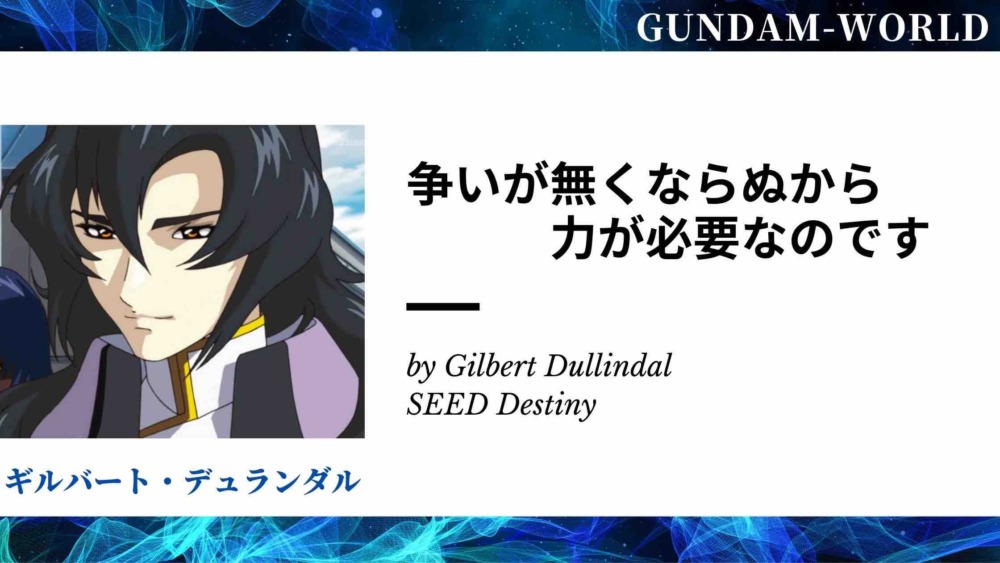
In the opening episode of Mobile Suit Gundam SEED Destiny, Cagalli and Gilbert Durandal disagree about the relationship between weapons and conflict. Their exchange gives us a memorable example of how a calm, courteous sentence can carry a fundamental political disagreement.
The quote in context
いいえ姫、争いが無くならぬから、力が必要なのです。
Gilbert Durandal, Mobile Suit Gundam SEED Destiny, Episode 1
Our translation: “No, Princess. It is because conflict persists that we need power.” This is our own English rendering for commentary, not the wording of a particular licensed subtitle or dub.
Cagalli’s concern is that excessive power invites further conflict. Durandal reverses the direction of the argument: if conflict will continue, power is necessary. The disagreement is not merely about how many weapons exist. It is about what each speaker accepts as the starting condition.
Power, force, and the breadth of conflict
力 (chikara) can mean power, strength or force. “Power” keeps the Japanese word’s breadth. “Military force” makes the immediate context clearer, but also supplies an explanation that the Japanese leaves to the scene. A translation can be accurate while choosing a different balance between precision and openness.
争い (arasoi) is broader than the word “war.” It can include disputes and struggles as well as armed conflict. Translating it as “war” sharpens the military setting, while “conflict” retains the broader claim about human relationships.
無くならぬ (nakunaranu) is a firm, somewhat formal negative expression: conflict does not disappear. Our “persists” keeps the English compact. “Will never end” sounds more absolute about the future, so it is a stronger interpretive choice.
The courtesy is part of the persuasion
Addressing Cagalli as 姫 (hime), “Princess,” acknowledges her position even while rejecting her argument. It is not an informal quarrel. The courteous address allows the disagreement to sound controlled and respectful.
The ending のです (no desu) presents what came before as an explanation. Compare the blunt English “We need power” with “That is why we need power.” The latter makes Durandal sound as if he is clarifying a necessary conclusion. The Japanese delivery supports that persuasive effect.
What the argument leaves open
Acknowledging the possibility of conflict does not by itself answer who should hold power, how much is necessary, or who can question its use. Those unanswered questions are one reason to treat the speech as a character’s argument rather than the series delivering a simple rule for the real world.
The original Japanese essay uses the line to reflect on Gundam’s recurring struggle between peace and coercion. An English reader can begin with the same tension: can force prevent fighting without creating new reasons to fight?
On a rewatch, listen first to the politeness, then to the assumption inside the sentence. Durandal’s ability to make a disputed premise sound reasonable is as interesting as the premise itself. It helps explain why a short reply can reveal so much about his authority.
Series reference: Official SEED Destiny website (Japanese). For further commentary, return to our English article index.
Comments