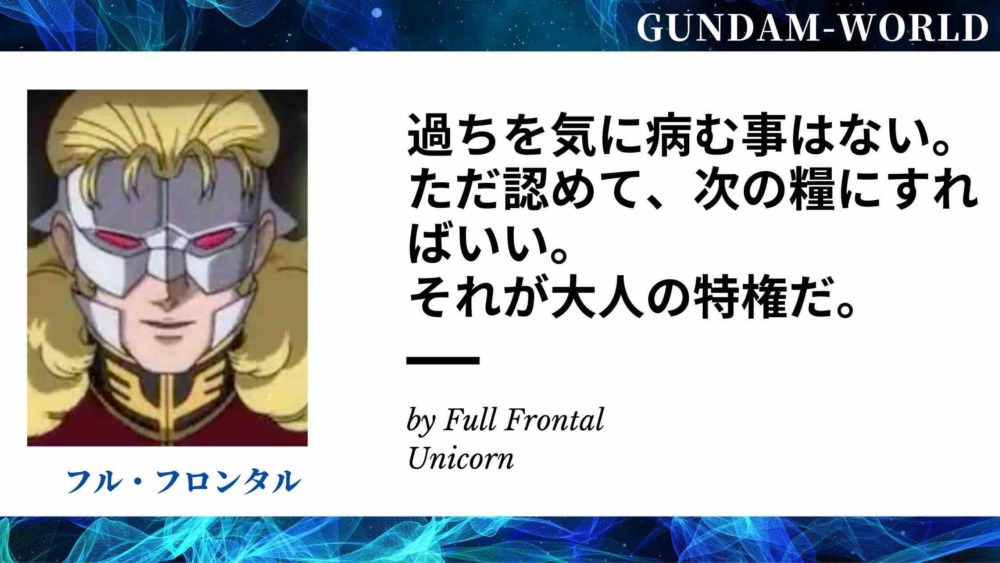
Full Frontal’s advice about mistakes is one of the most memorable lines in Mobile Suit Gundam Unicorn. It sounds reassuring, almost generous. Yet its effect changes when we remember who is speaking: a remarkably composed man whose resemblance to Char Aznable is central to his presence.
The line and an English rendering
過ちを気に病む事はない。ただ認めて、次の糧にすればいい。それが大人の特権だ。
Full Frontal, Mobile Suit Gundam Unicorn, Episode 2
Our translation: “There is no need to torment yourself over mistakes. Just acknowledge them and use them to grow. That is an adult’s privilege.”
This is an original translation for this commentary, not a transcription of an official English dub or subtitle track. Licensed English wording can differ between releases; a precise comparison needs an identified edition.
What the Japanese adds
気に病む (ki ni yamu) suggests allowing something to weigh on the mind. “Do not worry” is possible, but can sound too casual. “Do not torment yourself” brings out the emotional burden without implying that the mistake does not matter.
認める (mitomeru) is the crucial next step: acknowledge or admit it. The reassurance comes with responsibility. Frontal is not offering permission to deny a failure or to put its consequences on somebody else.
糧 (kate) literally evokes nourishment or sustenance. Here, a mistake becomes material for future growth. “Learn from it” is concise English; “use it to grow” preserves more of that nourishing image. Neither requires turning failure into something pleasant.
すればいい (sureba ii) gives the advice a measured, undramatic tone: this is what one can do next. The final 特権 (tokken), “privilege,” is more surprising. Maturity is presented as the freedom to respond constructively, rather than a demand to have been flawless all along.
Why Char’s shadow matters
Char’s famous reflection on youthful mistakes is remembered for his reluctance to acknowledge them. Frontal, by contrast, calmly makes acknowledgment the starting point. Hearing the two ideas side by side changes this from a generic piece of advice into a revealing contrast between characters.
Frontal’s mask, red mobile suit and voice invite that comparison before he explains himself. His confidence makes the line persuasive. It can also make the listener uneasy: the speaker’s composure is not proof that his broader view of humanity is right.
A useful lesson, with a limit
Our reading of the line is a reminder to live in the present. Regret can identify a problem, but repeated self-reproach alone cannot repair it. A practical response is to name the error, address the harm where possible, and change the next decision.
The limit matters too. Calling something a lesson should not end the conversation for those affected by it. Frontal’s wording begins with acknowledgment; skipping that step loses the part that makes the advice meaningful.
Revisit the scene in Episode 2 and listen to the calm delivery. Does the line feel compassionate, calculated, or both? That tension is what makes it worth returning to, even when its everyday lesson seems straightforward.
Continue exploring: Our Gundam Unicorn video guide (Japanese) · More English articles
Comments