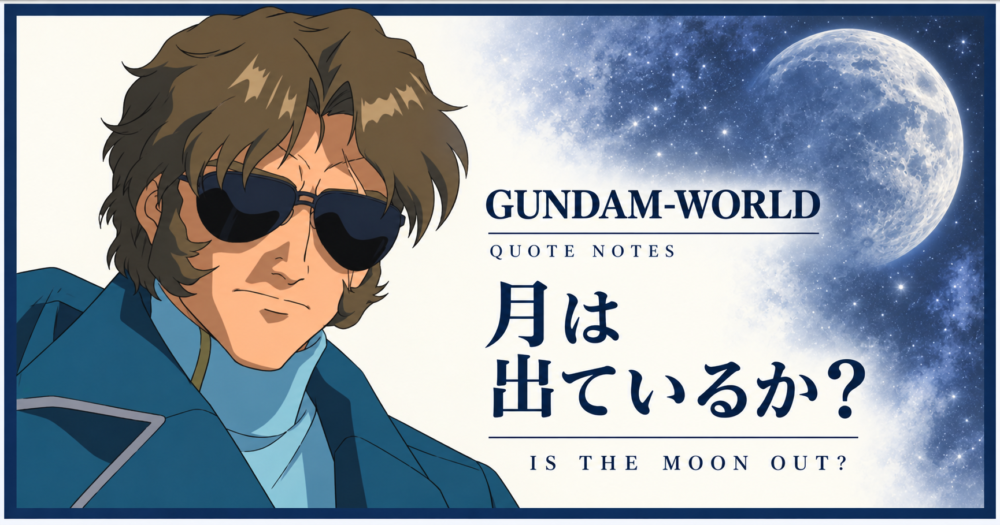
“Is the moon out?” matters in Gundam X because the original Satellite Cannon receives energy transmitted from a lunar facility. Jamil Neate’s question, 月は出ているか?, therefore has an immediate tactical meaning as well as a memorable, almost poetic sound. The weapon is not simply drawing power from reflected moonlight.
Spoilers: the opening premise and the Satellite Cannon’s role in After War Gundam X. Later revelations about the lunar facility are not explained. The English expressions below are our translations, not a transcript of a specific licensed release.
月は出ているか?
Jamil Neate · After War Gundam X
Tsuki wa dete iru ka? — “Is the moon out?”
A question about the weapon’s conditions
The original Gundam X’s Satellite Cannon depends on receiving a microwave energy transmission from the Moon. The official Gundam column explaining the phrase makes that connection explicit: being able to receive the transmission gives the Moon immediate importance to the battle. A question that could sound like idle observation becomes a check on the availability of extraordinary force. Source: official feature on the Moon in Gundam.
This is worth keeping separate from later equipment and stored-energy situations. “The moon is visible” is a useful explanation of the opening setup, not a universal technical rule for every X-related machine in every scene. The central idea is the energy link with the lunar system. It is not that the Moon produces enough ordinary light to charge a giant cannon directly.
Why give such a practical question a poetic shape?
The Moon usually suggests distance, stillness or romance. A question about seeing it invites the listener to look upwards. Gundam X lets that familiar image coexist with a weapon capable of immense destruction. The effect is unsettling because the beauty of the image does not need to change for its military meaning to become apparent.
Jamil’s knowledge helps create the gap. A new viewer may hear an enigmatic question. A person who knows the system hears a condition with immediate consequences. The line makes expertise dramatic without starting with a technical lecture. We first notice that the question matters, then learn what makes it matter.
Jamil, the past and the person asking
Jamil is a survivor of the earlier war, and his understanding of Gundams is burdened by that history. In our reading, the question gains weight because knowledge of the weapon is not the same as an innocent enthusiasm for using it. He can recognise what the system makes possible while carrying memories that complicate that possibility.
That distinction changes a rewatch. Instead of hearing the line only as an exciting signal that a powerful attack may follow, we can listen for the distance between knowing how to use force and being comfortable with it. The short question leaves room for both the practical calculation and the history behind the speaker.
What “dete iru” contributes to the translation
Tsuki is “moon,” marked here as the topic by wa. Dete iru describes it as being out or visible. The final ka makes the question explicit. “Is the moon out?” is natural English because English also uses “out” for a visible celestial body. “Has the Moon appeared?” is more literal in one respect but sounds as though its arrival is a new event.
“Can you see the Moon?” shifts attention towards the listener’s ability to see it. That may help explain the practical concern, but it introduces a personal subject that the Japanese question does not specify. Keeping “Is the moon out?” lets the line retain its spare quality. The technical explanation can follow outside the quote.
The opening title and a lasting image
The phrase is also the title of episode 1. The official 30th-anniversary screening announcement lists that title alongside the finale’s “月はいつもそこにある,” or “The Moon Is Always There.” Those titles create an invitation to compare an initial question with a later statement, without needing to treat the Moon as a single fixed metaphor throughout the series. Source: official anniversary screening announcement.
Three questions about the quote
Who asks “Is the moon out?” The line is associated with Jamil Neate in After War Gundam X; it is also the first episode’s title.
Does the cannon use moonlight? Its defining setup uses a microwave energy transmission from a lunar facility, rather than ordinary reflected sunlight.
Is the line only a metaphor? No. Its practical role comes first; the atmosphere and Jamil’s history give that practical question additional emotional force.
Compare another veteran’s relationship with a remembered battlefield in Gato’s declaration at Solomon. Setsuna’s “I am Gundam” likewise changes meaning when a machine is tied to a person’s earlier experience.
References: After War Gundam X; the official lunar-system explanation and episode-title listing. The official anniversary cast report also discusses Jamil’s question. The discussion of atmosphere and memory is our interpretation.
Featured image: original AI-generated fan illustration created for Gundam-World.







Comments