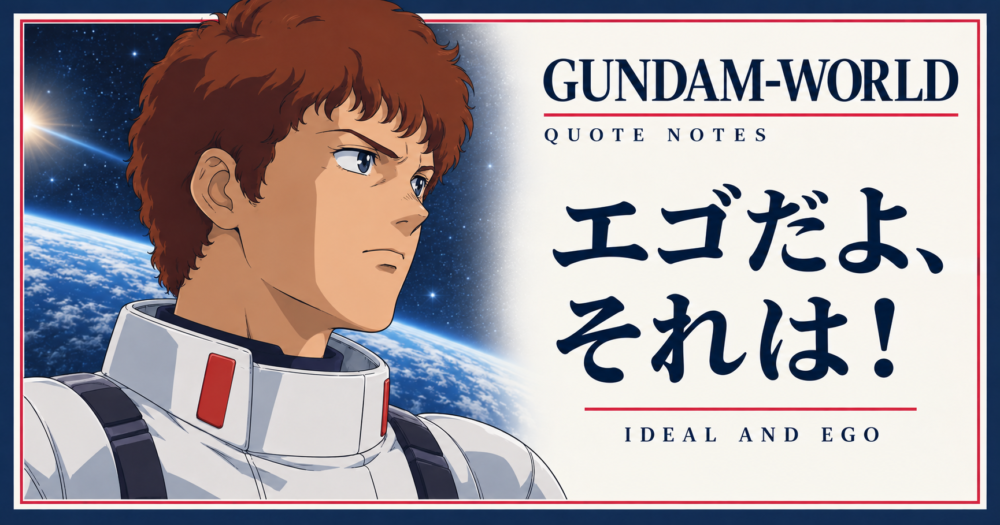
Amuro’s “Ego da yo, sore wa!” means that Char is imposing his own judgment on other people while presenting it as humanity’s necessary course. The line comes from Mobile Suit Gundam: Char’s Counterattack. “That’s ego!” preserves its distinctive wording; “That’s selfishness!” can make the accusation clearer in ordinary English, though each translation changes the emphasis.
Spoilers: Char’s aims and his confrontation with Amuro in Char’s Counterattack. The English translations in this article are our own, not transcriptions of an identified licensed subtitle or dub.
エゴだよ、それは!
Amuro Ray · Mobile Suit Gundam: Char’s Counterattack
Ego da yo, sore wa! — “That’s ego!”
What is Amuro objecting to?
Char has lost faith in the people and institutions that continue to dominate Earth. He seeks an enormous, coercive change, with the Axis drop forming the military threat around which the film’s conflict turns. Amuro fights to prevent the disaster. The official film synopsis describes Char’s Earth-cooling operation and Amuro’s attempt to stop Axis, establishing the material stakes behind their argument. Source: official film introduction.
Their disagreement is therefore not a polite dispute about whether society has problems. Both have lived through war and political failure. What divides them is also the authority Char grants himself to choose a violent remedy for everyone. Amuro’s reply makes the gap between an account of what is wrong and permission to inflict a solution painfully short.
Japanese “ego” is not always English “a big ego”
In everyday Japanese, ego often points towards self-interest or a self-centred insistence. English readers may first think of vanity, inflated self-esteem or a person who wants attention. Those associations can be relevant, but the line is not limited to telling Char that he thinks too highly of himself.
“That’s selfishness” foregrounds the objection that Char’s chosen answer gives his own conviction priority over other people’s lives and choices. “That’s your ego” makes the personal attribution more explicit. The first can sound morally direct; the second can sound like a psychological diagnosis. Neither should be allowed to replace the concrete question of what Char is doing.
A technical account of the ego in psychoanalysis would send the reader in another direction. The scene does not require Amuro to be using a clinical definition. It is a sharp accusation in an argument between two people with a long history, spoken while the stakes extend far beyond them.
Why put “sore wa” at the end?
Sore refers to “that”: the claim or course just put forward. Wa marks it as the topic. Japanese could place that reference first, but putting it after ego da yo lets the evaluation land before the pointed backward reference. The effect is close to an accusation followed by a finger directed at what the other speaker has just said.
English normally puts the reference at the front: “That’s…” This is natural, but it changes the order in which the audience receives the thought. Trying to preserve every part as “It’s ego, that is!” sounds strained. A translation can keep the force through rhythm and performance instead of reproducing the syntax mechanically.
Does the accusation settle the whole argument?
No single word can do that. Calling a proposal egoistic does not automatically repair a failing political system, and Amuro still has to act. Our reading is that the accusation changes the burden of justification: even if the complaint is real, the person proposing mass coercion must explain why his certainty should overrule the lives of those affected.
The personal history between Amuro and Char also prevents the exchange from becoming a detached philosophy lesson. They hear more in each other’s voices than the immediate policy claim. But treating the whole disagreement as nothing more than personal resentment would erase the people whose future is being decided around them. The film keeps both scales in contact.
Why the short line remains recognisable
The official 2021 Gundam Conference report describes a clip of Amuro and Char’s argument, including this line, being screened during a discussion of the franchise and society. That later use shows how readily the phrase can recall the conflict. It does not establish one authorised interpretation of every motive in the film. Source: official conference report.
Three questions about the quote
Who says it, and to whom? Amuro Ray says it to Char in Char’s Counterattack. It is not originally a line by Char about Amuro.
Does “ego” only mean arrogance here? It can also communicate self-centred insistence: allowing one’s own conviction to decide other people’s fate.
Is “That’s selfishness” the official English line? Here it is an explanatory translation option. A particular subtitle or dub needs to be checked directly.
Compare Kira’s refusal to abandon the world and Delaz’s language of a great cause. Both raise questions about what a sweeping conclusion leaves out. Char’s reflection on youthful mistakes offers an earlier, more private form of self-judgment.
References: Mobile Suit Gundam: Char’s Counterattack; the official film synopsis and conference report. The interpretation of coercion, authority and syntax is this article’s analysis.
Featured image: original AI-generated fan illustration created for Gundam-World.





Comments