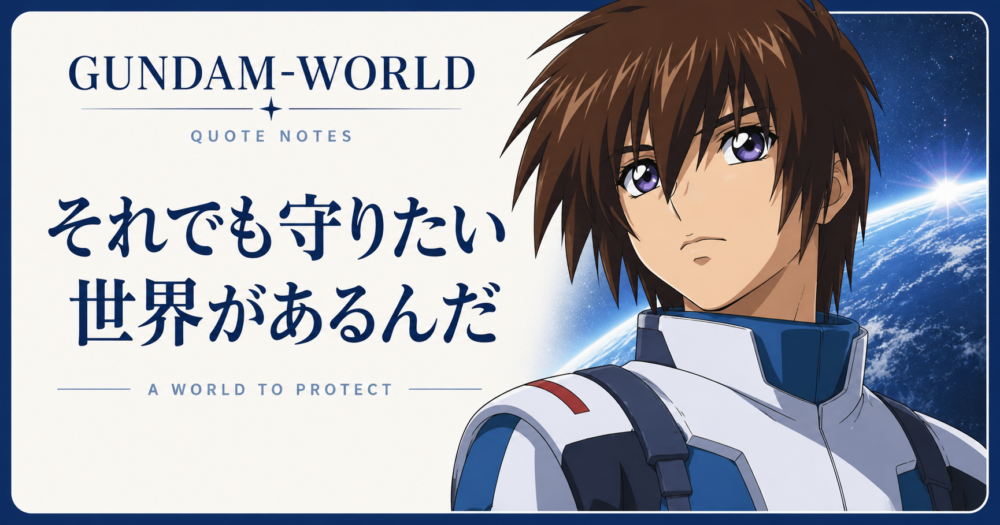
“Even so, there’s a world I want to protect” is Kira Yamato’s refusal to let humanity’s cruelty justify its destruction. He answers Rau Le Creuset in the final confrontation of Mobile Suit Gundam SEED. The opening “even so,” それでも, matters: Kira is choosing to protect something after hearing an argument for despair, not declaring that the world has no faults.
Spoilers: the original Gundam SEED’s final conflict and Kira’s confrontation with Rau Le Creuset. English wording below is our translation for analysis, rather than a quotation from an identified English subtitle or dub edition.
それでも守りたい世界があるんだ
Kira Yamato · Mobile Suit Gundam SEED
Soredemo mamoritai sekai ga aru n da — “Even so, there’s a world I want to protect.”
What Kira is answering
Rau’s challenge works through the violence and contradictions people have already created. That makes a simple denial inadequate. If Kira only replied that people were good and nothing was wrong, the argument would leave the suffering the audience has witnessed untouched. His answer takes a different route: the existence of cruelty does not establish that every person and every future should be discarded.
The line belongs to SEED, rather than being a new declaration originating in SEED Destiny. The original Japanese TV series reaches this scene in episode 50; the current HD-remaster story listing numbers the final installment 48. Both use the title “終わらない明日へ.” Checking the edition explains why searches can return different numbers for the same final confrontation.
“Even so” accepts a difficulty before resisting a conclusion
Soredemo refers back to the difficulty already on the table. Depending on context, English can use “even so,” “nevertheless” or “despite that.” “But” is possible too, although it can sound more like the speaker is interrupting or rejecting the preceding point outright. The longer expression leaves acknowledgment audible.
In our reading, that acknowledgment is the line’s strength. Kira does not need to redeem the history of every institution before defending the people who might live beyond this battle. The sentence moves from an argument about what humanity deserves towards a commitment about what he is prepared to protect. It is a response with personal responsibility, not a complete theory of justice.
What does “world” mean here?
Sekai can mean the world broadly, but the sentence does not force us to imagine only a planet viewed from space. A person’s world also includes relationships, places and possibilities that make life meaningful. The people Kira has come to know make his commitment concrete, without making everyone outside that circle disposable.
“There’s a world I want to protect” preserves the Japanese structure with an existence statement. “I still want to protect this world” is smoother in another way, but adds “this” and shifts the rhythm towards the speaker’s continuing desire. Either can help explain the sentiment. Neither should be passed off as the wording of a licensed release without checking that edition.
The quiet force of “mamoritai” and “n da”
Mamoritai means “want to protect.” It states a wish or commitment rather than a guarantee of success. That matters for a character whose ability to act has repeatedly exceeded his certainty about what action should achieve. The line gives him a reason to fight without promising that he can prevent every loss.
The closing n da gives the statement an explanatory or insistent cast in context. Kira is making the reason for his resistance audible. Translating it with an extra slogan such as “and that’s the truth” would add a flavour the Japanese does not require. The surrounding clash and the delivery can carry the insistence more effectively than additional English words.
Why a hopeful line still belongs in a difficult scene
The sentence is moving because hope arrives after injury, not before it. It does not turn the fight into a painless victory or make Kira’s decisions immune to criticism. A useful rewatch question is whether a given action protects the possibility he names, and what cost that action imposes on someone else. The declaration is a starting point for judging his conduct, not a shortcut around judgment.
Its lasting recognisability is reflected in a first-hand report from the 2019 Taipei Game Show: Soichiro Hoshi entered the stage after delivering Kira’s line. That supports its association with the character, while an event performance remains distinct from a transcript of the anime. Source: Famitsu’s stage report.
Three questions about the quote
Who says it? Kira Yamato, addressing Rau Le Creuset in Gundam SEED’s final conflict.
Does he mean the world is perfect? No. The “even so” keeps its failures in view while resisting a destructive conclusion.
Is this article quoting an official English dub? No. The English is our translation; edition-specific dialogue needs to be checked against the relevant release.
Read Banagher’s “even so” for another use of the same connective. Amuro’s accusation of ego asks a related question about imposing a conclusion on humanity, while Durandal’s account of conflict and power offers a different SEED-era answer.
References: Mobile Suit Gundam SEED’s final confrontation; Famitsu’s first-hand cast-event report. The language and character analysis are this article’s interpretation.
Featured image: original AI-generated fan illustration created for Gundam-World.





Comments