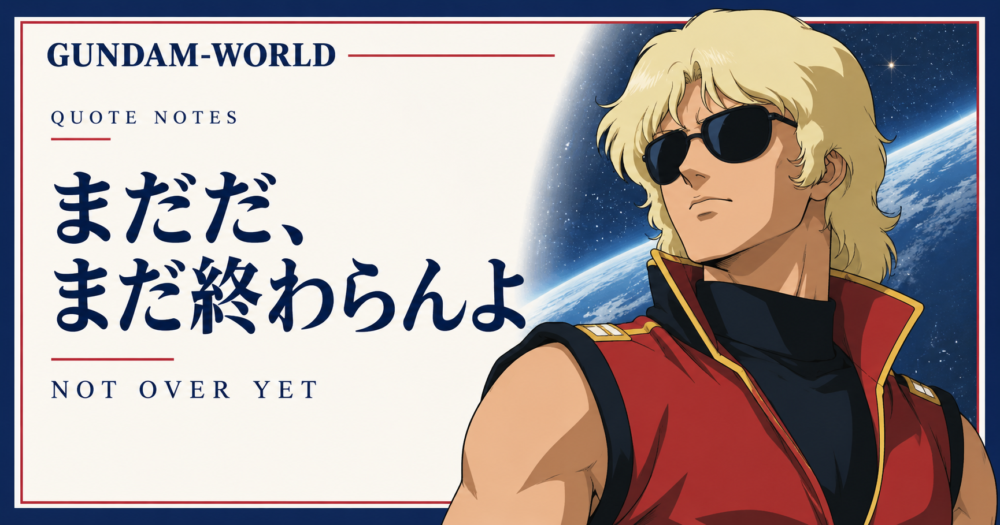
“Mada da, mada owaran yo” means “Not yet. It’s not over yet.” The speaker is Quattro Bajeena, Char Aznable’s identity in Mobile Suit Zeta Gundam. In the television finale, the line is a refusal to accept that an apparently losing position has already settled the outcome. Its force comes from danger, rather than from confidence that victory is assured.
Spoilers: Quattro’s identity and the television finale of Zeta Gundam. The English translations here are our own; they are not a transcription of a licensed English subtitle or dub. The discussion follows the TV series rather than treating the compilation films as interchangeable.
まだだ、まだ終わらんよ
Quattro Bajeena · Mobile Suit Zeta Gundam
Mada da, mada owaran yo — “Not yet. It’s not over yet.”
Quattro or Char: who should receive the quote?
Both names refer to the same man, but Quattro identifies the role he occupies in Zeta. Using that name keeps the scene attached to this part of his history. It avoids making every Char quote sound as though it comes from the masked Zeon officer of the first series or the Neo Zeon leader of Char’s Counterattack.
The official introduction to Char Aznable: All Utterances explicitly groups the line among Quattro’s Zeta dialogue. The official Power Word listing also attributes it to Quattro. Those references support the distinction even when fans use “Char” as the umbrella name. Official book introduction; Power Word 169.
A line spoken under pressure
The television finale places Quattro and the Hyaku Shiki amid the conflict with Haman Karn and Paptimus Scirocco. The circumstances strip away the idea that a veteran’s reputation will make him untouchable. The official dialogue-goods announcement identifies the quote with episode 50, “宇宙を駆ける,” confirming its place in the TV ending. Source: official dialogue-item announcement.
Our reading is that the line asserts a remaining capacity to act. Quattro cannot declare the danger nonexistent. What he can reject is the opponent’s right to treat the next moment as already decided. That is a much narrower, and more precarious, claim than saying that he is the strongest pilot or that he has everything under control.
Why repeat “mada”?
Mada can mean “still” or “yet,” depending on its construction. The first mada da is a compressed “not yet.” The second occurrence attaches the refusal to ending: mada owaran. Repetition lets the first beat interrupt the apparent conclusion and the next beat state what is being denied.
English can keep that shape with “Not yet. It’s not over yet.” A smoother “It’s not over!” loses the initial beat and the repeated word. “I’m not finished yet” makes the speaker’s personal condition more explicit, but narrows the Japanese, which leaves the subject of ending unstated. That subject can encompass his resistance and the immediate battle.
Owaran is a negative form of “end,” giving a different register from the more everyday owaranai. In this voice it contributes to the forceful, compact sound. The final yo presses the statement towards the listener; it is not the same use as the direct address to a place in Gato’s “Solomon yo.” Identical particles can do different work in different constructions.
Persistence without an easy victory lesson
The quotation often travels as encouragement to continue a project or recover from a setback. That use is understandable, but the scene itself remains less tidy. Refusing to concede does not guarantee a favourable ending, and survival is not the same as winning the larger political struggle. The gap between declaration and outcome is part of the line’s dramatic strength.
It also lets us see a familiar person in a different posture. Char is often remembered for commentary that places him above someone else’s mistake. Here the voice comes from inside the danger. The sentence does not provide a safe distance from the contest; it is part of staying in it. That shift makes it more revealing than a detached display of coolness.
Three questions about the quote
Is it Char’s line? Yes, spoken under his Quattro Bajeena identity in the Zeta television series.
Which episode? The official dialogue-item announcement identifies Japanese TV episode 50, “宇宙を駆ける.” A compilation-film comparison needs to identify the film separately.
Does “not over” promise victory? No. The sentence denies that the end has already arrived; it does not state how the remaining action must turn out.
Read Char’s reluctance to accept youthful mistakes for a more reflective form of his speech. Gato’s declaration of return shows another veteran using a short announcement, while Orga’s “Don’t stop” turns continuing into a message for others.
References: Mobile Suit Zeta Gundam, TV finale; official episode attribution, Power Word listing and book introduction. The reading of persistence and syntax is our interpretation.
Featured image: original AI-generated fan illustration created for Gundam-World.





Comments