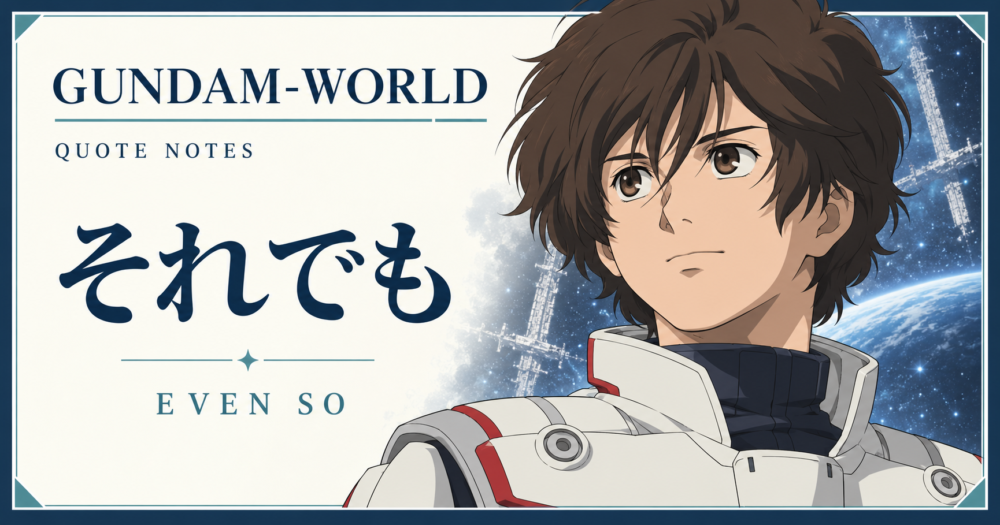
Banagher’s “soredemo” (それでも) means “even so”: the facts may be painful, but they do not have to settle every future possibility. In Mobile Suit Gundam Unicorn, the phrase becomes a thread connecting encouragement, argument and action. It is especially important to distinguish Marida Cruz urging Banagher to keep saying it from the choices Banagher himself makes afterward.
Spoilers: the middle and later ideological conflicts of Gundam Unicorn, including Marida’s encouragement and Full Frontal’s worldview. English renderings here are our translations for commentary, not transcriptions of a licensed dub or subtitle track.
それでも
A recurring expression in Mobile Suit Gundam Unicorn
Soredemo — “Even so.”
Why this ordinary Japanese expression carries so much weight
On its own, soredemo is an everyday connective expression. It refers back to what has just been said or established, then introduces something that remains true despite it. “Even so” keeps that relationship visible. “Nevertheless” is another option, although it can sound more formal. Neither translation automatically contains a promise that everything will improve.
That structure is the reason the phrase suits Banagher. An opponent can describe real grievances, failed institutions or repeated human cruelty. Banagher does not have to prove that none of those things happened before he can object to the conclusion that follows. He can accept the difficulty and still resist the claim that there is only one possible response.
Marida’s encouragement and Banagher’s response are different acts
Marida’s encouragement gives Banagher a way to continue when a persuasive explanation seems to close off hope. She is not simply supplying an argument he can repeat word for word. She is urging him to preserve the ability to answer. The significance lies partly in who offers that encouragement: someone with her own experience of being treated as an instrument rather than a person.
Banagher then has to decide what continuing means in practice. Saying “even so” is not the same as having a workable plan, and encouragement does not remove responsibility for the next action. This distinction keeps the expression from becoming a magical solution. Another person can help him find his voice, but cannot make every decision for him.
Does “even so” mean ignoring reality?
It can, if someone uses the phrase to avoid listening. The more interesting reading in Unicorn is the opposite: the objection has to be heard for the reply to have any force. “Even so” without a preceding difficulty is merely a slogan. “Even so” after acknowledging a difficulty leaves an opening where a final verdict might otherwise stand.
Full Frontal’s calm manner makes that opening especially important. A complete-looking explanation can feel reassuring because it gives suffering a pattern and offers a definite course. Banagher’s resistance asks whether a tidy account of human behaviour is entitled to define the limits of everyone’s future. This is our interpretation of the dramatic contrast, rather than a claim that the words alone refute Frontal’s proposals.
The publisher’s description of Gundam UC Bande Dessinée volume 17 explicitly connects Banagher’s “soredemo” with retaining hope before Frontal’s account of the universe. It confirms the phrase’s importance in the manga adaptation; it should not be used as a transcript or episode guide for the OVA. Source: KADOKAWA’s volume description.
What an English translation should leave unfinished
“But” is shorter, but can sound like an immediate interruption or a straightforward contradiction. “Even so” allows a little more acknowledgment of what came before. “Despite that” makes the backward reference explicit. Which works best depends on the sentence, the delivery and how much of the preceding exchange an audience can hear.
The temptation is to expand the quote into “I know everything will be fine.” That adds a certainty the Japanese does not contain. A more faithful explanation is that the speaker refuses to let present evidence exhaust the meaning of possibility. The phrase is small enough to leave room for doubt, and that room makes the resolve feel earned.
Three questions about the quote
Is “soredemo” uniquely Banagher’s invention? No. It is ordinary Japanese, made distinctive through repetition and context. Marida’s encouragement is part of its dramatic inheritance.
Does it translate as “I believe”? Not literally. It means “even so” or “nevertheless”; belief is supplied by the situation and what the speaker chooses next.
Is every “soredemo” line the same scene? No. A recurring expression and a particular speaker’s sentence should not be collapsed into one quotation. Check the edition and scene when comparing subtitles.
Continue with Kira’s “Even so, there’s a world I want to protect”, where the same connective introduces a concrete commitment. Full Frontal’s advice about mistakes offers another view of his persuasive calm.
References: Mobile Suit Gundam Unicorn; KADOKAWA, Bande Dessinée volume 17. The comparison between encouragement, realism and possibility is this article’s reading.
Featured image: original AI-generated fan illustration created for Gundam-World.






Comments