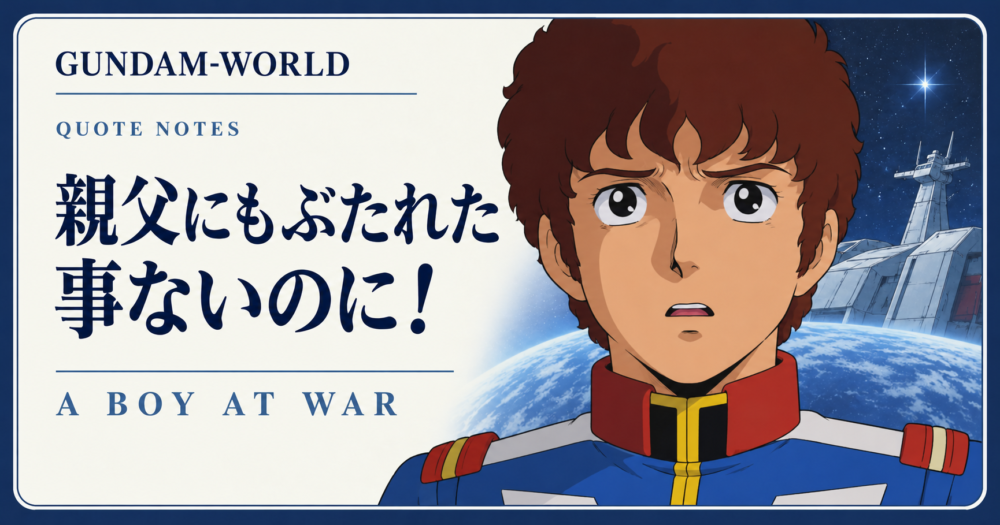
Amuro’s “Even my father never hit me!” is a shocked protest after Bright slaps him in episode 9 of the original Mobile Suit Gundam. The Japanese, 親父にもぶたれた事ないのに, compares the treatment he is receiving now with the life he knew before becoming the Gundam’s pilot. It makes the gap between a civilian teenager and the role forced onto him audible.
Spoilers: the confrontation between Amuro and Bright in Japanese TV episode 9, “翔べ!ガンダム.” English renderings are our explanatory translations, not transcriptions of an identified licensed subtitle or dub.
親父にもぶたれた事ないのに!
Amuro Ray · Mobile Suit Gundam
Oyaji ni mo butareta koto nai noni! — “Not even my father has ever hit me!”
What happens in episode 9?
Bright and Amuro clash over his refusal to go into battle. Bright strikes him, and the familiar protest follows a second blow. The official original-series quote feature identifies the speaker, episode and sequence, including the longer wording that mentions being struck twice. The short phrase remembered on its own is therefore part of an escalating exchange. Source: official quote feature.
Amuro’s ability to operate the Gundam has made him indispensable to people trying to keep White Base alive. But a useful skill does not automatically give its possessor the emotional resources of an experienced soldier. He can be exceptionally capable in combat and still be a frightened, exhausted young person. The scene becomes thinner if only one side of that description is allowed to remain.
What “even my father” actually tells us
Oyaji is a familiar, rougher way to refer to a father. In this sentence, the comparison treats his father as someone from whom such treatment might have been expected more readily than from Bright. The negative claim makes the surprise stronger: it has not happened even within that earlier relationship.
That is a statement about being hit, not a complete report on whether his childhood was happy, whether his father was always attentive or whether he had faced any other hardship. A short line of protest cannot establish an entire family history. Its immediate purpose is to tell Bright that the boundary Amuro took for granted has been crossed.
Why “noni” leaves a protest hanging
Butareta koto nai describes not having had the experience of being hit. English can use “has never hit me” to connect that absence to the present. The Japanese passive puts the experience on the person receiving it, while natural English often makes the father the grammatical subject. Both routes can preserve the comparison.
The final noni points towards a clash between expectation and reality: “even though…” or “and yet…” Something implied is left for the listener to supply. Amuro does not need to finish with a formal explanation of why the situation feels wrong. The unfinished contrast carries the emotional complaint.
“Even my father never hit me!” is concise and readily understandable English. “Not even my father has ever hit me!” makes the negative scope more explicit. Adding a complete “so you have no right” clause would explain one possible implication, but it would also turn an emotional outburst into a more settled argument than the original wording provides.
Bright’s pressure and Amuro’s limits
Bright is responsible for people in an emergency, and Amuro’s refusal has immediate consequences. Understanding that pressure helps explain the confrontation. It does not mean the scene must become an endorsement of striking someone as necessary education. We can recognise the fear on both sides while still noticing the harm and the failure to communicate.
Our reading is that the encounter reveals a system improvising adulthood too quickly. A ship needs a pilot; the available pilot is a boy who did not enlist for this life. The argument exposes the human cost of converting exceptional ability into an unlimited obligation. That remains interesting even after the quoted sentence has become familiar enough to imitate.
How the meme changes the balance
The isolated line makes Amuro’s comparison with his father the whole joke. In the episode, the audience also has to remember the repeated battles, the ship’s dependence on him and Bright’s limited room for error. Restoring those conditions changes the question from “Why is he complaining?” to “What can reasonably be demanded of him, and how is it being demanded?”
Three questions about the quote
Who hits Amuro? Bright Noa does, during their episode 9 confrontation. The father is mentioned as a comparison, not as the person striking him in this scene.
Does the line prove Amuro had a perfect childhood? No. It states his lack of one particular experience; it does not describe every aspect of his upbringing.
What does the ending “noni” add? It leaves an aggrieved contrast hanging between what he expected and what has happened.
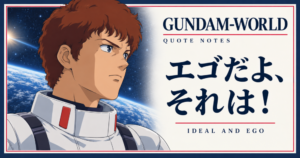
Compare Heero’s abrupt threat to Relena for another boy whose relationship with military duty disrupts ordinary social life. Amuro’s later “That’s ego!” shows him challenging a different kind of imposed authority as an adult.
References: Mobile Suit Gundam, Japanese TV episode 9; official episode and quote explanation. The discussion of obligation, violence and grammar is our interpretation.
Featured image: original AI-generated fan illustration created for Gundam-World.
Comments