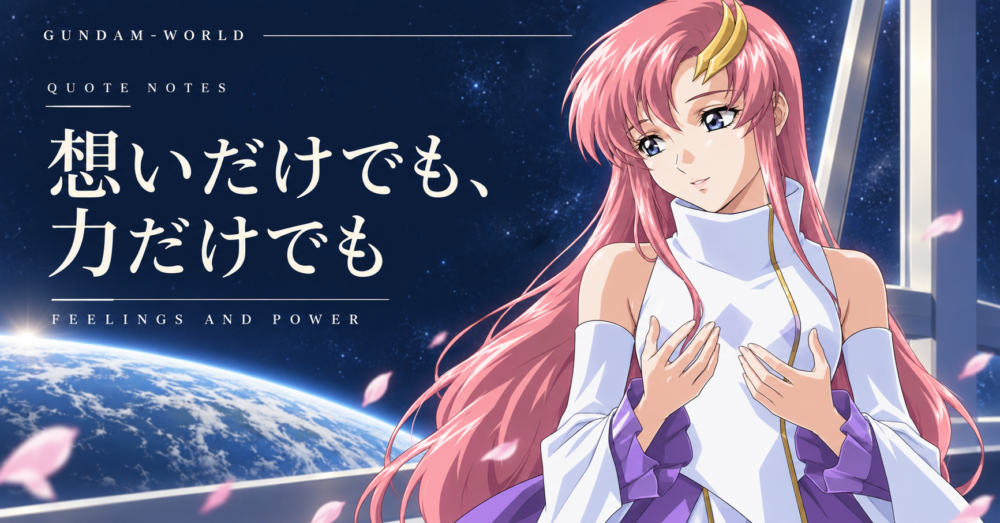
Lacus Clyne’s words about “feelings alone” and “power alone” mean that a wish needs the ability to act, while that ability needs a purpose. In Mobile Suit Gundam SEED, she gives the idea weight by entrusting Freedom to Kira. The line is not a claim that possessing a stronger machine automatically makes the possessor right.
Spoilers: Lacus and Kira’s Freedom handover in Gundam SEED. English renderings below are our translations for analysis, rather than a transcription of an identified licensed subtitle or dub.
想いだけでも、力だけでも
Lacus Clyne · Mobile Suit Gundam SEED; short excerpt
Omoi dake demo, chikara dake demo — “Feelings alone, power alone…”
Why the line belongs with the Freedom handover
The official story guide places Lacus’s decision to give Freedom to Kira in “まなざしの先.” The original TV designation is PHASE-34; the HD-remaster story listing presents it as the 32nd installment. The action gives a practical form to the pairing: she recognises a wish to protect, then makes a means of acting available. Source: official story guide.
A weaker version of the idea would simply tell Kira that his feelings are admirable. A purely instrumental version would only tell him that the machine is powerful. The balanced line refuses both shortcuts. What he cares about matters, and so does what he can actually do with the means he receives.
What “omoi” contains
Omoi can cover feelings, thoughts, wishes or heartfelt intentions according to context. “Feelings” keeps the emotional quality, but may sound too vague in English if readers imagine only a private mood. “Good intentions” makes the ethical direction easier to understand, while adding an evaluation that the Japanese word alone does not always supply.
Here the surrounding relationship gives the word its direction. Kira’s concern for people is not merely a feeling to be admired from afar; it is something that must guide decisions under pressure. Translating omoi as “intentions” can bring that forward, provided the reader does not mistake a helpful explanation for a different Japanese sentence.
Power means capacity as well as force
Chikara can mean power, strength or the ability to make something happen. Freedom makes the military meaning immediate, but the broader sense matters to the argument too. A person can care deeply and still lack the means to affect an outcome. Recognising that limit is not the same as dismissing the feeling.
Conversely, capacity does not determine its own proper use. A machine can enable rescue or destruction; a pilot still has to choose. The line therefore makes power answerable to an intention rather than treating greater force as a substitute for judgment. That is our reading of why the pairing belongs at this decision point.
The balance created by “dake demo”
Dake marks “only” or “alone.” Repeating the construction for both halves puts them on the same grammatical level. The pattern denies sufficiency to each in isolation. It does not say that intentions are worthless, nor that power is inherently the only thing that counts.
A natural explanatory English version is “Neither feelings alone nor power alone is enough.” That supplies the conclusion to make the short excerpt readable. “You need both purpose and the means to act” explains its practical force, but moves further away from the wording. Distinguishing a translation from an explanation helps preserve the elegant parallelism.
Lacus’s calm delivery does not make the decision passive
Softness of tone can obscure how decisive the act is. Lacus is not merely standing beside a choice someone else has already made. Entrusting the machine changes what Kira can do next. Her words attach responsibility to that intervention without turning it into a speech about her own authority.
This also makes the line a useful test for later action. Does the means still serve the purpose, or has using it become an end in itself? Does the purpose remain concrete enough to guide a difficult choice? The sentence opens those questions; it does not guarantee that every later decision will answer them well.
Three questions about the quote
Is Lacus saying feelings are useless? No. The repeated “alone” denies sufficiency, not value. Her pairing requires that a purpose and a means of acting inform one another.
Which scene does it belong to? The Freedom handover to Kira in SEED, associated with original PHASE-34 and the HD listing’s 32nd installment.
Is “good intentions” the only correct translation of omoi? No. It clarifies a contextual meaning, while “feelings,” “wishes” and “intentions” bring different shades forward.
Continue with Kira’s world he wants to protect, which names the purpose more directly. Durandal’s words about conflict and power and Cagalli’s objection to retaliation offer different SEED-era challenges to the use of force.
References: Mobile Suit Gundam SEED; official Freedom-handover guide; ORICON’s report on the official episode stream; Rie Tanaka’s cast-event performance. Language and character analysis are our interpretation.
Featured image: original AI-generated fan illustration created for Gundam-World.








Comments