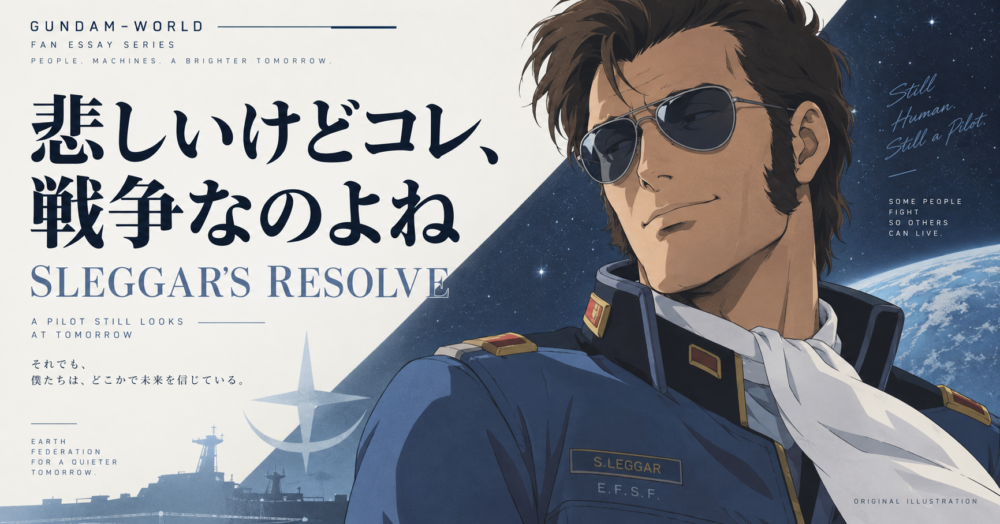
“Sad, but this is war” is Sleggar Law’s acknowledgement that knowing the cost will not remove the immediate need to fight. His Japanese line, 悲しいけどコレ、戦争なのよね, comes during the battle against Dozle Zabi’s Big Zam in the original Mobile Suit Gundam. Its familiar, almost conversational ending makes the moment more painful, rather than less serious.
Spoilers: Sleggar’s farewell to Mirai and his final combat scene at Solomon. The English wording below is our explanatory translation; wording and performance can differ between licensed releases.
悲しいけどコレ、戦争なのよね
Sleggar Law · Mobile Suit Gundam
Kanashii kedo kore, sensō nano yo ne — “Sad, but this is war.”
Where does Sleggar say it?
The line belongs to the confrontation with Big Zam during the Battle of Solomon. In the Japanese television numbering, the relevant episode is 36, “恐怖!機動ビグ・ザム” (the Big Zam episode). Sleggar goes into the attack knowing the danger. The official quote feature places the sentence in his exchange with Amuro as the attack develops. Source: official original-series quote feature.
Before returning to battle, he leaves a ring he describes as a keepsake from his mother with Mirai. The gesture brings a private future into a scene governed by military necessity. We have been allowed to see something he might wish to return to. When he speaks about war, the cost is therefore no longer an abstract idea; the audience has just been shown a relationship that could have continued.
Why the light tone makes the line hurt
Sleggar’s public manner is relaxed and flirtatious. It makes him stand apart from the strain that often fills White Base. That manner does not disappear when the stakes rise. He does not replace his personality with a grand ceremonial speech simply because the scene is approaching a fatal decision.
The effect is recognisably human: people can use familiar speech to make a frightening truth speakable. His ease can be read as a way of carrying the burden in front of another person. It does not prove that he feels nothing. The word “sad” remains in the sentence, and the action around it gives the admission weight.
What “nano yo ne” adds in Japanese
Kanashii kedo establishes the emotional concession: “it is sad, but…” The deictic kore, “this,” brings the claim back to what is happening in front of him. He is not presenting a distant definition of war in a textbook. He is recognising the situation that he and Amuro currently inhabit.
The ending nano yo ne is difficult to move into a single English phrase. It combines an explanatory cast with a conversational appeal to recognition. Depending on delivery, an English “you know” or “isn’t it” might suggest part of that shared awareness, but either addition can also make the sentence sound too casual or too questioning. There is no one-word equivalent.
It is also unhelpful to reduce the ending to “feminine language” and stop there. Japanese endings carry associations, but a character’s voice depends on the full utterance and performance. Here the relaxed register, the admission of sadness and the battlefield situation work together. The point is the peculiar gentleness with which Sleggar accepts something harsh.
G-Fighter or Core Booster? Keep the versions separate
The television series uses the G-Fighter and its G-Armor combination with the Gundam in this sequence. The compilation film version gives Sleggar the Core Booster, as also identified in Bandai’s official model-development blog. Those are different versions of the scene, not interchangeable names for a single craft. A remembered image of a Core Booster does not mean a television description using G-Armor is automatically mistaken.
For the quote’s meaning, the shared dramatic situation matters most: Sleggar commits himself against Big Zam alongside Amuro. For a scene-by-scene comparison, however, it is worth checking which edition you are watching before identifying the machine or transcribing the precise timing of a line.
Resignation does not make the loss acceptable
The sentence can sound like a shrug when printed alone. In context it acknowledges the sadness before continuing into danger. That is different from saying that war makes every loss morally acceptable, or that caring about the person who dies is naive. The farewell and the line work together to preserve the cost, even as the battle presses forward.
Compare Gato’s “Solomon, I have returned”, spoken at the same location years later. One line treats Solomon as the witness to a return; the other stays close to the people who must act in the present. Ramba Ral’s “No Zaku” offers another example of a veteran’s unmistakable personality surviving inside a short combat line.
Quick answers
Who says the line? Sleggar Law, not Amuro or Char. Does its casual ending mean he is joking? The tone is familiar, but the scene takes the danger seriously. Why do clips show different aircraft? The television and compilation-film versions use different machines; identify the edition before comparing the visuals.
References: Mobile Suit Gundam, Japanese TV episode 36, and Mobile Suit Gundam III: Encounters in Space; official features on the quote and Sleggar’s character. Language and emotional interpretation are this article’s analysis.
Featured image: original AI-generated fan illustration created for Gundam-World.


Comments