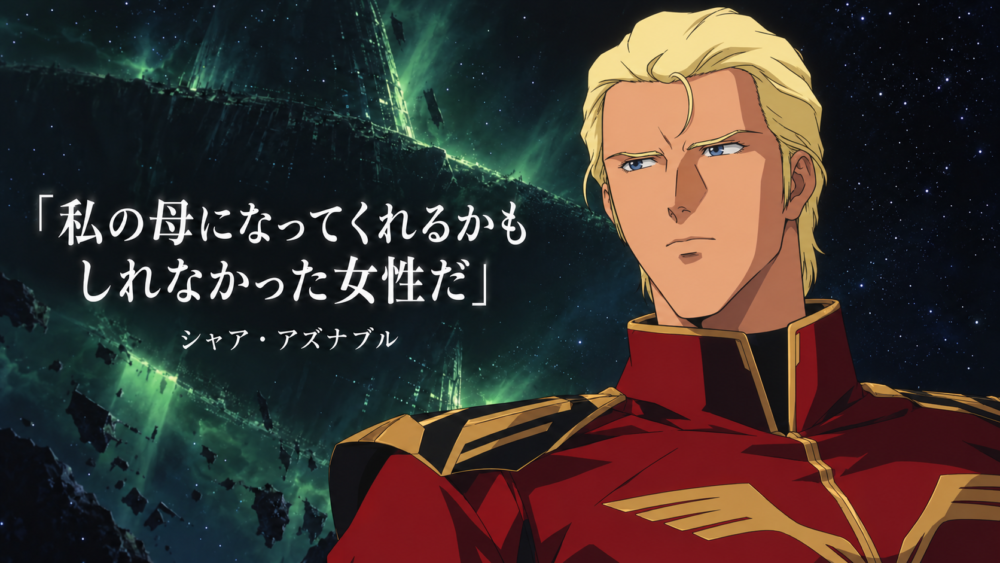
日本語:「ララァは私の母」の意味は?シャア最後の台詞とアムロの反応を解説
Disclosure: This article contains affiliate advertisements. As an Amazon Associate, this site earns from qualifying purchases. The cover and scene illustration are AI-assisted images created for this site.
Spoilers for the ending of Mobile Suit Gundam: Char’s Counterattack.
Who says it, and where?
- Work: Mobile Suit Gundam: Char’s Counterattack.
- Speaker and listener: Char Aznable, speaking to Amuro Ray.
- Version: the 1988 theatrical film, not a numbered television episode.
- Scene: their final conversation as the Nu Gundam, carrying Char’s escape pod, attempts to push the falling Axis away.
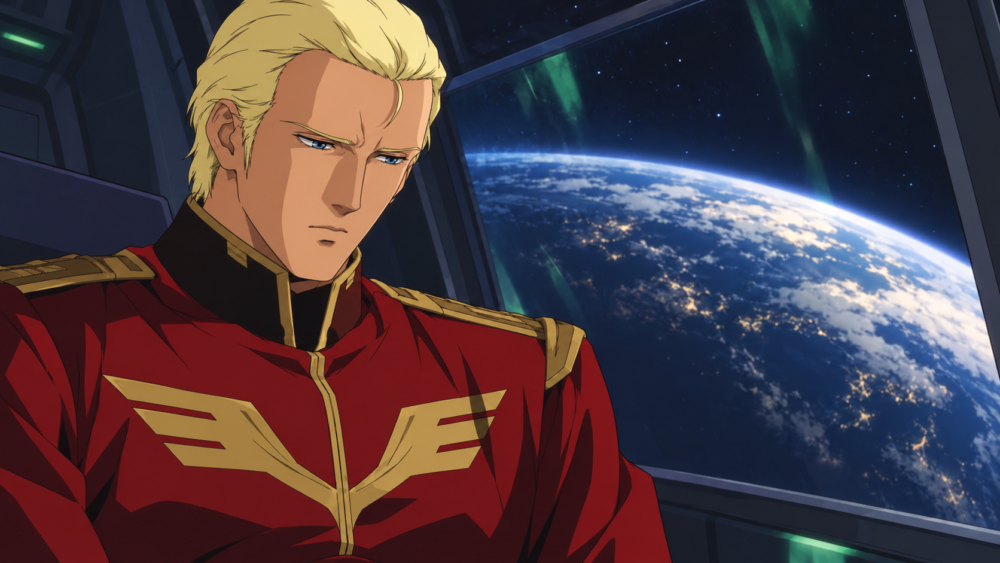
Char is not revealing that Lalah is his biological mother. He describes a relationship she might have provided, using the word “mother” for a possibility that has been lost. The wording matters before any psychological interpretation begins.
What does the Japanese line actually say?
ララァ・スンは私の母になってくれるかもしれなかった女性だOur explanatory translation is: “Lalah Sune was a woman who might have become a mother to me.” This is an editorial rendering, not a quotation from a particular official English subtitle or dub.
The phrase is often shortened to “Lalah was my mother.” That loses the unrealised possibility in the Japanese. Char does not say that she already became his mother, nor simply that she will become one. He looks back at something he believes could have happened and no longer can.
What did Lalah mean to Char?
Lalah was a Newtype on Char’s side during the One Year War. She also experienced a profound connection with Amuro and died while protecting Char in battle. Her death remains part of the emotional history between the two men.
Seeing Char only as the powerful protector makes his confession more difficult to understand. A person’s public position does not necessarily reveal what they privately need from someone else. Age, military rank and the role of rescuer cannot fully explain the emotional role he gives Lalah here.
This article stays with the 1988 film. It does not import details from The Origin or GQuuuuuuX as if all versions shared an identical account of Char and Lalah’s relationship.
Why use the word “mother”?
One reading is that Char longs for someone who could accept his vulnerability as well as his strength. A man who presents himself as a leader and rival ends by describing a personal loss. “Mother” can express a wish for emotional shelter, rather than a literal family relationship.
That is an interpretation, not a clinical diagnosis. The line cannot establish a real-world psychiatric explanation for every decision Char makes. A dismissive label may capture the surprise of the confession while missing the history and grief around it.
Char’s hope also should not be mistaken for proof of Lalah’s own wishes. He describes what she might have become for him. The sentence does not establish that she wanted, or would have agreed, to take on that role.
Why is Amuro surprised?
Amuro’s startled response exposes a difference in how the two men understood Lalah. Both remember her intensely, yet they have not been remembering the same relationship. That difference finally becomes explicit at the end of their long rivalry.
Isolated from the scene, the reaction can sound like a punchline. In context, the men reach a deeply private subject with almost no time left to discuss it. The possibility of understanding arrives alongside the failure to achieve it.
Public ideals and private grief
The film’s conflict involves the future of Earth and humanity. Its final conversation returns to the memory of one person. The contrast does not make every political argument meaningless; it shows how public convictions and unresolved personal emotions can coexist.
Reading both layers keeps the line connected to the whole film. Char is neither only an abstract political position nor only a single emotional wound. His confession reveals something that his grander language could not fully contain.
A related model rather than quote merchandise
The standard RG Sazabi is a related model representing Char’s mobile suit in this film. It is not an item bearing the quoted line. The standard kit must be distinguished from Special Coating and MSN-04FF releases. Check the grade, equipment, seller and condition of the particular offer before ordering.
Frequently asked questions
Which episode contains Char’s mother line?
It appears near the end of the 1988 theatrical film Char’s Counterattack. It is not a numbered television episode.
Is Lalah actually Char’s mother?
No. Char is describing an unrealised emotional relationship, not biological parentage.
Is there only one correct interpretation?
The wording and scene can be identified. Explanations involving acceptance, dependence or loneliness remain interpretations and should be presented as such.
Related reading
- Char’s “If It Doesn’t Hit” Quote: Meaning, Episode & Japanese
- “That’s Ego!”: What Amuro Means in Char’s Counterattack
- “Nu Gundam Isn’t Just for Show”: Amuro’s Quote Explained
- Gundam F91 & Char’s Counterattack Theme Songs: Official Listening Guide
Comments