日本語で読む · English
Spoilers for episode 2 of the original Mobile Suit Gundam TV series. English renderings of the line below are our translations, not official subtitle or dub quotations.
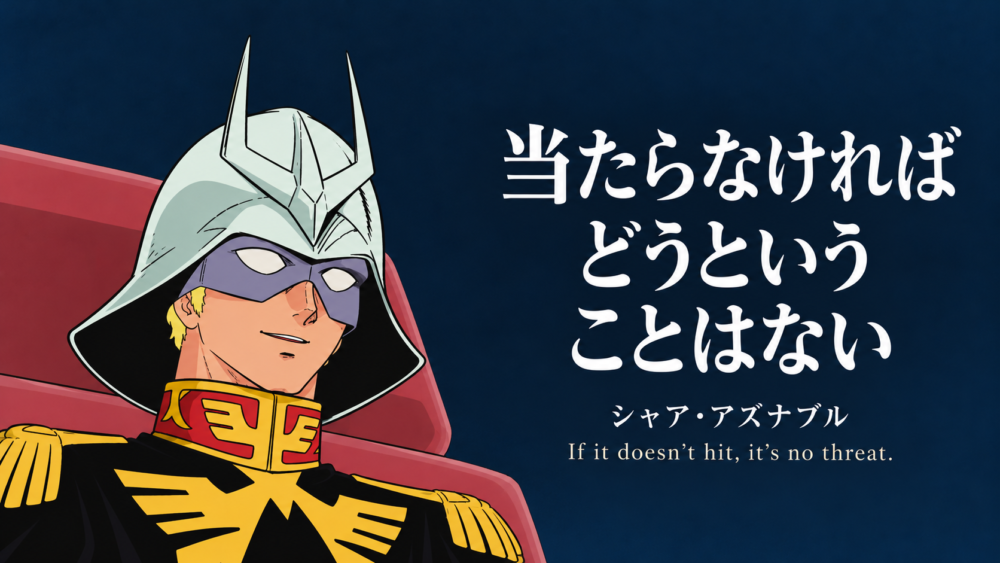
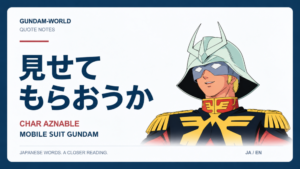
Char Aznable’s “If it doesn’t hit, it’s no threat” comes from episode 2 of the original Mobile Suit Gundam TV series. The Japanese line is 「当たらなければどうということはない」 (Ataranakereba dō to iu koto wa nai). Char says it to his subordinate Slender as they confront the Gundam’s beam rifle.
The appeal lies in the condition. Char does not promise that a Zaku can withstand the weapon. He treats avoiding the shot as the answer. That calm confidence makes him formidable—and raises a question about how much he expects of the men flying beside him.
Which episode is Char’s “If it doesn’t hit” quote from?
| Speaker | Char Aznable |
|---|---|
| Series | Mobile Suit Gundam, original 1979 TV series |
| Episode | Episode 2, Japanese title 「ガンダム破壊命令」 |
| Listener | Slender, a pilot under Char’s command |
| Context | Char’s Zaku encounters the Gundam’s powerful beam rifle |
「当たらなければどうということはない」
“If it doesn’t hit, it’s no threat.”
Char Aznable, episode 2 / our English rendering
This is communication with an ally, rather than a taunt delivered directly to Amuro. That distinction changes its tone. We hear an officer answering a subordinate’s concern, not simply a rival boasting at the hero.
The scene: a powerful new weapon meets an experienced pilot
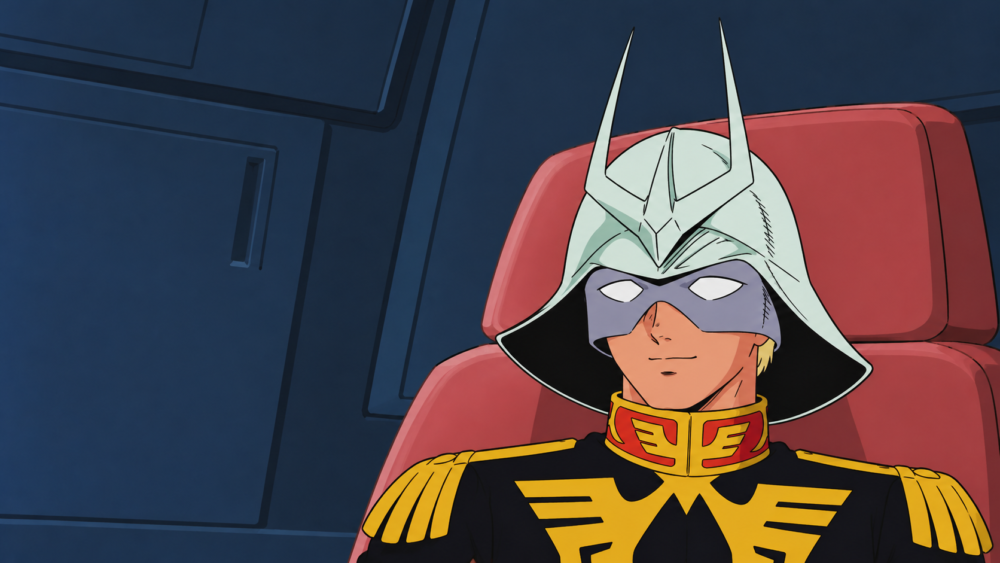
After White Base leaves Side 7, Char approaches in his red Zaku. His speed and experience make an immediate impression, while Amuro fights in a machine whose abilities he is still learning.
The Gundam’s beam rifle creates a different problem from ordinary gunfire. Char’s skill does not make a direct hit safe. The official episode guide describes a Zaku being destroyed by the rifle and Char withdrawing in fear of its power. The episode therefore gives his confident remark a limit: evasion is a tactic, not invulnerability.
What does the quote mean?
The condition matters: “if it doesn’t hit”
The opening ataranakereba means “if it does not hit.” It leaves the weapon’s destructive force intact and moves the problem to the pilot’s ability to avoid it. Char is effectively changing the question from “How can our armour survive that?” to “Why let it connect?”
That shift captures the early rivalry. The Gundam brings unfamiliar firepower; Char brings combat experience. Amuro has not yet mastered his machine. The line invites us to watch whether a veteran’s judgement can overcome that difference in hardware.
“It’s no big deal”: confidence without a raised voice
Dō to iu koto wa nai is a dismissive expression: something is no great problem, or nothing much to worry about. An urgent command to dodge would sound very different. Char makes the same danger sound manageable.
For Slender, that composure may be reassuring. It can also sound like a demanding standard: the commander’s ability to evade does not automatically belong to every pilot under him. This is our reading of the exchange, rather than an official statement about Char’s private thoughts. Both possibilities help explain why the line remains interesting beyond its use as a confident catchphrase.
How is it different from “Show me the Gundam’s performance”?
Char’s “Show me the performance of the Federation’s mobile suit” line also belongs to episode 2. There, he is assessing an unknown opponent. Here, he is expressing confidence in how he will deal with its attack.
One line presents the observer, the other the pilot. Together they show a man who wants to understand the enemy while trusting his own skill. The episode’s retreat keeps that confidence from being a simple guarantee of victory.
Japanese nuance and three possible English translations
There is no need to turn the line into “You can’t hit me.” That adds an unconditional boast absent from the Japanese grammar. The original keeps an if; Char’s assurance comes from treating the condition as something he can satisfy.
| Our rendering | What it emphasises |
|---|---|
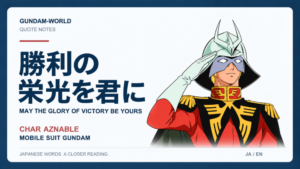
| If it doesn’t hit, it’s no threat. | The tactical point: a powerful shot must connect to do damage. Used on this article’s cover. |
| If it doesn’t hit, it’s no problem. | A more casual dismissal, close to the everyday sound of the Japanese ending. |
| As long as it misses, there’s nothing to worry about. | A reassuring address to a teammate, though more explanatory than the compact Japanese line. |
Official subtitles and dubs should be checked against the particular release being watched. These examples explain the Japanese; they are not presented as quotations from any licensed English track.
Finding the scene—and the Japanese spelling
Look for episode 2 of the original TV series, identified by the Japanese title 「ガンダム破壊命令」. Watching the communication with Slender and the battle’s outcome gives more context than an isolated clip. The official episode page includes a synopsis and stills.
The expression is also written 「当たらなければどうという事はない」, using the kanji 事 instead of hiragana こと. COSPA uses that spelling for its officially licensed quote T-shirt. The meaning does not change. We use hiragana in our main heading for readability.
Frequently asked questions
Is Char saying this to Amuro?
No. The remark is addressed to his subordinate Slender. It answers concern about the Gundam’s weapon during their engagement.
Does the quote mean a Zaku can survive a beam-rifle hit?
No. It depends on avoiding the hit. The point is confidence in evasion, not the Zaku’s armour.
Is “If it doesn’t hit, it’s no threat” the official English quote?
It is our rendering for this article. Wording in a particular English subtitle or dub track needs to be checked against that release.
Sources and related reading
- Official episode 2 guide: episode title, battle outline and reference stills.
- Official Char Aznable profile: character design reference.
- COSPA licensed T-shirt information: Japanese wording.
- Supplementary Japanese dialogue reference: unofficial line and episode cross-check.
For another side of Char’s early confidence, read his assessment of the Gundam’s performance. Browse more scenes in our Gundam quotes collection.

Comments