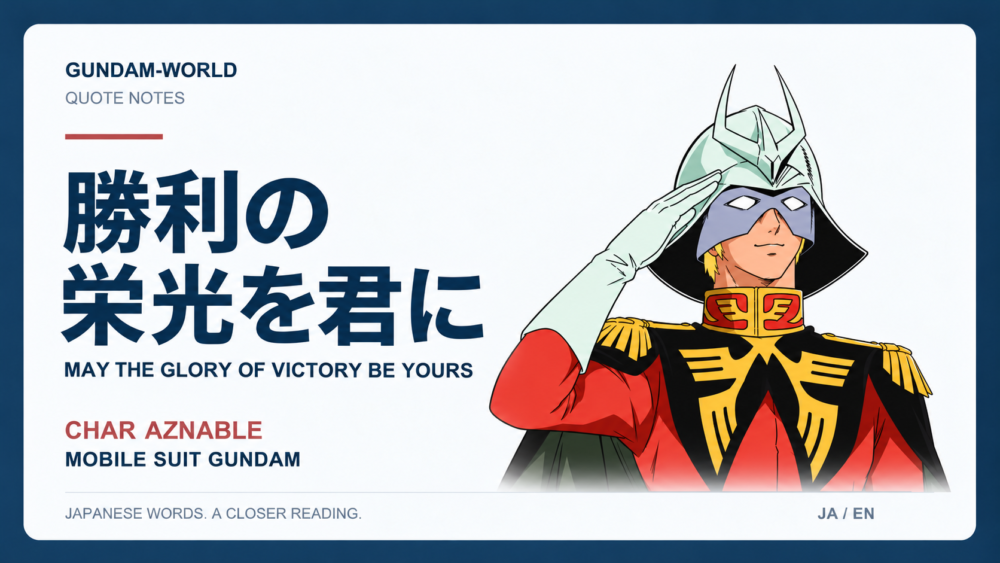
Char’s “Shōri no eikō wo kimi ni” offers Garma the glory of victory before the sortie in the original Gundam’s episode 10. It accompanies an outwardly supportive farewell, not the later revelation delivered at the moment of Garma’s death. The irony comes from hearing a wish for another person’s success while Char is helping determine a very different outcome.
Spoilers: Garma’s fate and Char’s betrayal in Japanese TV episode 10. English renderings are our translations, not an identified licensed subtitle or dub.
勝利の栄光を君に!
Char Aznable · Mobile Suit Gundam
Romanization: Shōri no eikō wo kimi ni!
Our translation: “May the glory of victory be yours!”
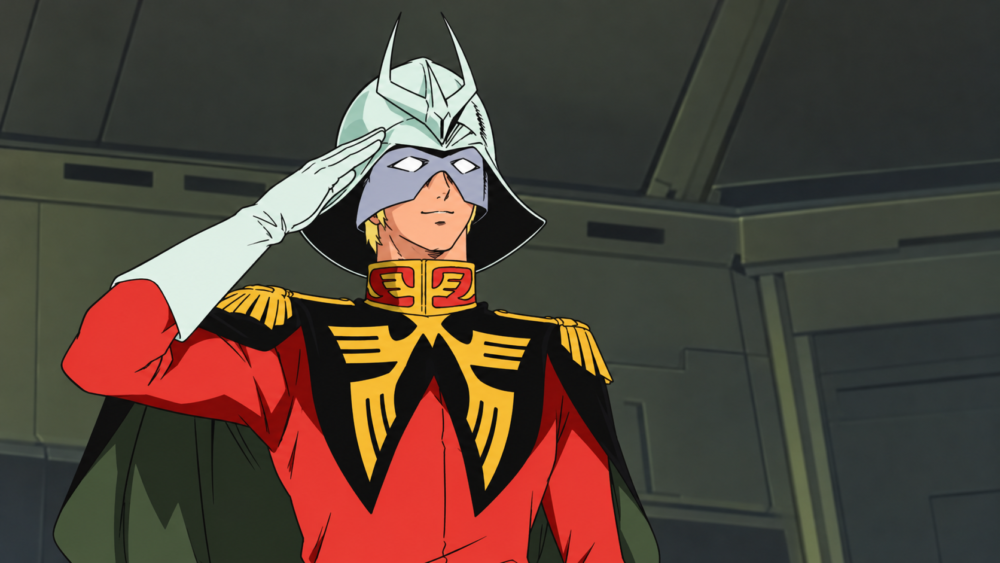
A salute before the sortie, not the final betrayal line
The timing should be kept clear. Char gives Garma an encouraging-looking send-off before the operation. Later, his actions and his disclosure of betrayal change the meaning of that earlier courtesy. Combining those beats into one deathbed quotation loses the gap in knowledge that makes the sequence work.
Garma can receive the farewell as support from someone he trusts. The viewer’s later understanding exposes a second layer. A sentence can be entirely conventional in its surface meaning and still be used by a speaker whose intentions make the convention cruel. Char does not have to announce that cruelty for it to become audible in retrospect.
What is being offered in Japanese?
Shōri is victory and eikō is glory. The phrase presents the glory as something directed to kimi, “you.” The sentence leaves the act of giving or wishing unstated. That compact construction makes it sound like a dedication or a toast, rather than a report that victory has already happened.
English usually supplies a verb to make the wish natural: “May the glory of victory be yours.” “Victory and glory to you” is more compressed, but changes the relationship between the two nouns. “You will win” turns the wish into a prediction and loses the ceremonial quality. Those differences matter when the person speaking cannot be trusted.
What “kimi” contributes
Kimi directly addresses the other person, in a register that can sound familiar or assured depending on the relationship. It is not automatically affectionate in every Japanese sentence. Here it helps the words sound personally offered to Garma, rather than being a generic military slogan shouted to a crowd.
That personal direction sharpens the betrayal. The line does not merely celebrate an abstract cause; it appears to grant the coming success to this listener. Garma’s expectation and Char’s private purpose can coexist inside the same familiar form of address without either being explained aloud.
Why politeness can be more unsettling than an insult
Our reading is that Char’s control is the memorable feature. An openly hostile farewell would give Garma information he could act on. The graceful one preserves the relationship’s appearance long enough for the plan to continue. Courtesy functions as part of the action, not merely as decoration around it.
That does not mean the words have a secret dictionary meaning equivalent to “you are doomed.” Their ordinary meaning remains a wish for success. The scene makes the contradiction through intention and circumstance. Understanding that distinction keeps translation from manufacturing a hidden threat that the Japanese does not literally state.
Official English merchandise is not the same as a dub
The official STRICT-G announcement presents the line on clothing alongside an English inscription. That is evidence of the phrase’s enduring recognition and of a licensed merchandise rendering. It should not be silently used as proof of the exact words in a particular English anime performance. Source: official STRICT-G announcement.
A translation for this commentary can therefore supply the natural English wish while keeping its status clear. The important comparison is how the concise Japanese and the expanded English each carry the surface generosity. The later betrayal supplies the irony in both languages.
Three questions about the quote
Is it said at Garma’s final moment? The encouraging salute comes before the sortie. It should be distinguished from Char’s later revelation of betrayal.
Does the Japanese literally threaten Garma? No. The surface offers a wish for glory; knowledge of Char’s actions changes how the audience hears it.
Why use “may” in English? It makes the unstated wish explicit without turning the sentence into a guarantee of victory.
For another line shaped by the aftermath of Garma’s death, read Char’s “Bouya dakara sa”. Char’s appraisal of the Gundam shows a different use of his controlled, indirect speech.
References: Mobile Suit Gundam, episode 10; official quotation merchandise. The reading of courtesy and dramatic irony is ours.
Comments