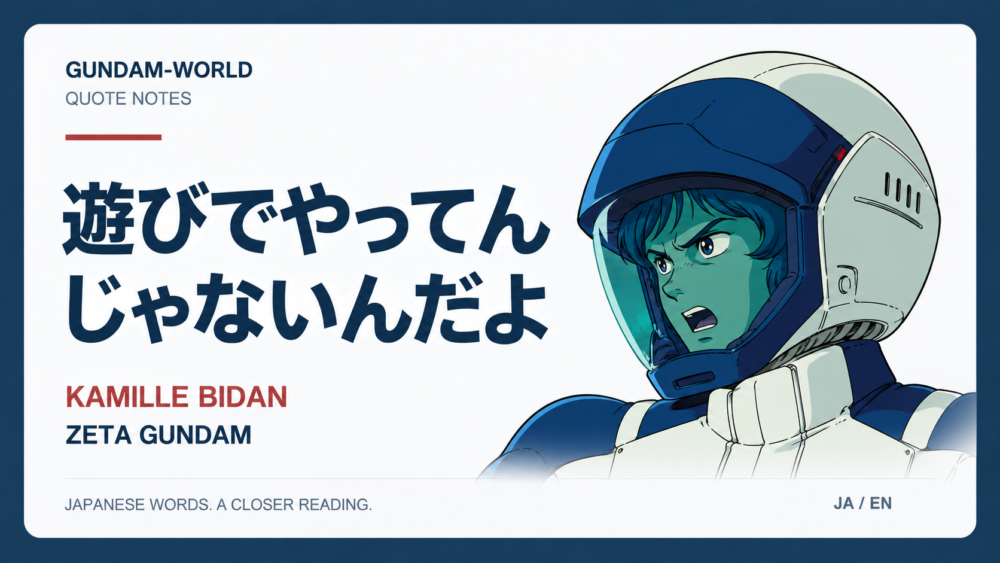
Kamille’s “Asobi de yatten ja nai n da yo!” is an angry rejection of treating a lethal battle as amusement. He directs it at Yazan Gable in the late television series of Mobile Suit Zeta Gundam. “This isn’t a game!” is a natural English explanation, but the original also carries the sense “I’m not doing this for fun.” The distinction reveals what he objects to.
Spoilers: the late-TV-series fighting and Kamille’s confrontation with Yazan. English translations below are ours, rather than the dialogue of an identified licensed English edition.
遊びでやってんじゃないんだよ!
Kamille Bidan · Mobile Suit Zeta Gundam
Romanization: Asobi de yatten ja nai n da yo!
Our translation: “I’m not doing this for fun!”

Which scene does the line belong to?
Bandai’s official dialogue-item announcement reproduces the short line and identifies the relevant late-series episodes; Kamille’s expression is associated with Japanese TV episode 49. The opponent is Yazan, whose enjoyment of battle brings Kamille’s anger into sharp focus. This is the television climax, rather than an interchangeable scene from the compilation films. Source: official dialogue-item announcement.
The surrounding deaths make “fun” an intolerable category for Kamille. He is not complaining that his opponent is insufficiently committed to winning. Yazan’s skill is part of what makes the encounter frightening. The objection concerns what another person’s death has become to someone who is very good at causing it.
“Asobi” is broader than a competitive game
Asobi means play, recreation or amusement. It can include games, but does not require an organised game with rules and a score. Translating it as “game” is idiomatic English because English uses the same metaphor to reject treating consequences lightly. “For fun” brings the motive of enjoyment closer to the surface.
“I’m serious!” is another possible explanation, but it is too small to do all the work. Someone who enjoys killing can also be serious about the contest. Kamille’s line is stronger when we retain the question of pleasure: why is this battle something anyone would want to prolong for the experience of fighting it?
What the compressed Japanese sounds like
Yatten is a compressed spoken form related to yatte iru, “doing.” The negative construction rejects the explanation that this is being done as play. The closing n da yo gives the utterance an emphatic, explanatory thrust in this context: the listener is being made to recognise what the speaker thinks should already be obvious.
An English “This isn’t a game!” shifts the grammatical focus from the speaker’s activity to the situation itself. That can be effective, especially when the voice and action show what is at stake. “I’m not playing around!” stays closer to the speaker but can sound like a warning that he is about to become more ruthless. No single option escapes the need for context.
Anger that does not make the situation simple
Our reading is that Kamille’s anger preserves an ethical distinction while placing him under enormous strain. He objects to enjoying the destruction of people, yet he is still inside a battle and using force. The line does not transport him to a position outside the violence he condemns.
That tension makes the outburst more revealing than a tidy statement of principle. He cannot simply stop the war by finding the correct words. His sensitivity makes the losses matter, but the same sensitivity makes continuing through them increasingly difficult. A declaration of seriousness cannot make that burden disappear.
How internet repetition changes the stakes
Detached from Yazan and the deaths around the scene, the phrase can become a comic assertion that a hobby or match is being pursued intensely. The joke rests on applying the scale of the original anger to something with much smaller stakes. Recognising that use does not require mistaking it for the original subject of the sentence.
A useful rewatch restores the listener. Ask what Kamille hears in Yazan’s attitude and why it enrages him now. The line becomes a response to another person’s way of fighting, rather than a generic sound made whenever Kamille loses patience.
Three questions about the quote
Who is Kamille addressing? Yazan Gable in the late-TV-series confrontation, not Jerid in their opening encounter.
Does “asobi” literally mean a video game? No. It covers play or amusement; “game” is an idiomatic English choice in this situation.
Is the line only a claim that Kamille wants to win? No. It objects to the treatment of lethal combat as something enjoyable.
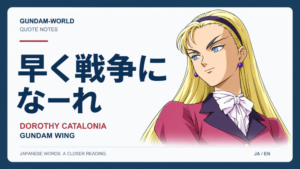
Compare Dorothy’s wish for war for another disturbing link between war and apparent pleasure. Sleggar’s “Sad, but this is war” acknowledges the human cost in a very different tone.
References: Mobile Suit Zeta Gundam, late TV episodes; Bandai’s quote and episode attribution. The discussion of enjoyment, grammar and anger is our analysis.


Comments