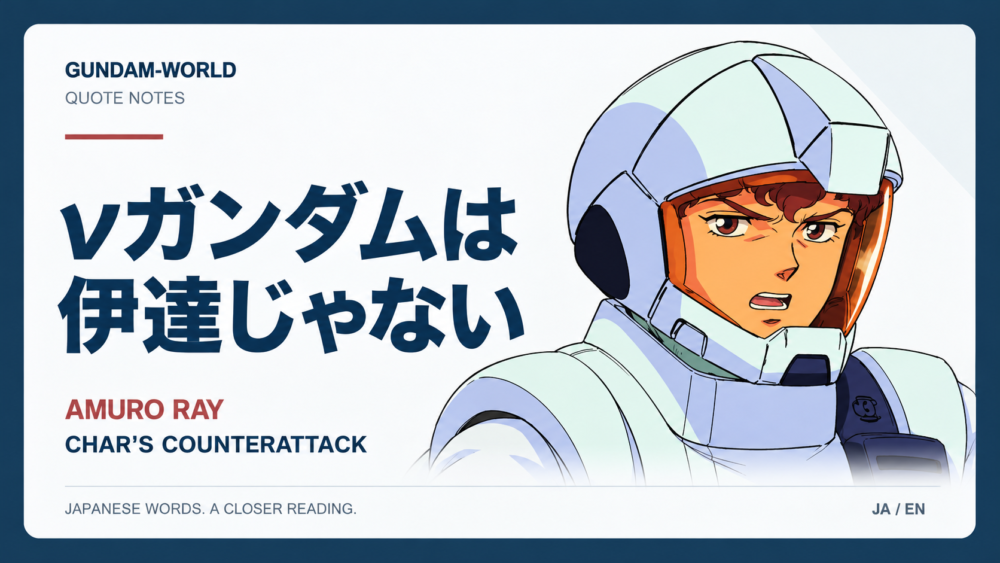
“Nu Gundam isn’t just for show!” is an English rendering of Amuro’s νガンダムは伊達じゃない. He makes the declaration while trying to push Axis away from Earth in Mobile Suit Gundam: Char’s Counterattack. The Japanese idiom date ja nai means that something has substance beyond its impressive appearance or reputation; it is not about going on a romantic date.
Spoilers: the Axis climax of Char’s Counterattack. English wording here is our translation for commentary, not a transcription of an identified English dub or subtitle edition.
νガンダムは伊達じゃない!
Amuro Ray · Mobile Suit Gundam: Char’s Counterattack
Romanization: Nyū Gandamu wa date ja nai!
Our translation: “Nu Gundam isn’t just for show!”

Where Amuro says it
The official Power Word listing identifies the line with Amuro’s attempt to push Axis back. The official Gundam Perfect File feature also connects the quotation to that scene. It is therefore a declaration made during a desperate physical intervention, not a general test-range claim about which mobile suit has the best specifications. Power Word 185; official scene feature.
That setting matters to the scale of the boast. A mobile suit is being asked to participate in something far beyond an ordinary duel. The declaration is emotionally convincing because it is made from inside the attempt. Amuro is not observing the crisis and announcing confidence on someone else’s behalf; he is committing his own machine and action to it.
What does “date ja nai” mean?
Date in this expression concerns showiness or a display that could be empty. The negative rejects that emptiness. “Not just for show” makes the implication natural in English: the name and appearance are backed by real ability. “Not just decoration” is another explanatory option, although it can sound as if the machine were literally an ornament.
“The Nu Gundam is the real thing” foregrounds authenticity. “The Nu Gundam lives up to its name” foregrounds reputation. Both explain part of the idiom, but neither reproduces every shade. The short negative is effective because it leaves the speaker to demonstrate what makes the claim true.
A machine Amuro helped bring into being
The official character profile describes Amuro’s work on the new machine and his determination to stop Char’s forced transformation of the world. That links the declaration to something he has helped make, rather than to an impressive weapon delivered without personal involvement. Source: official Amuro profile.
Our reading is that the line compresses trust, technical knowledge and will. Amuro knows the machine as a pilot and as someone involved in its development. Yet the circumstances exceed a comfortable calculation of specifications. Trust is becoming action at the point where a detached assessment might say the effort is insufficient.
Why it is more than a power-ranking slogan
The climax involves people and phenomena beyond a single pilot’s equipment. Reducing the line to “Nu Gundam can always do anything” removes the pressure that gives it force. It is a declaration in one extreme situation, not an engineering guarantee that all danger has disappeared.
The same limit makes the scene more moving. If the machine could perform the task effortlessly, there would be little courage in believing in it. The audience sees a demand being placed on a name and a design. The boast tries to make room for one more act of resistance before accepting catastrophe.
What the Japanese rhythm preserves
The topic marker wa sets Nu Gundam apart: as for this machine, the impressive exterior is not empty. The colloquial ja nai keeps the declaration direct rather than ceremonial. English can preserve that economy with “isn’t,” while an expanded explanation such as “has capabilities beyond appearances” loses the urgency.
The Greek letter ν is read nyū, conventionally written “Nu” in the mobile suit’s English name. Keeping that spelling distinguishes the name from merely calling it “the new Gundam.” The name matters because Amuro’s sentence makes that particular machine answer the crisis.
Three questions about the quote
What does “date” mean here? Show or display, in an idiom rejecting something that is merely impressive on the surface.
Is the line from the first Gundam TV series? No. It belongs to Amuro’s Axis intervention in the film Char’s Counterattack.
Does it establish that Nu Gundam is invincible? No. Its drama depends on the enormity of the attempt, not on an assurance that defeat is impossible.
Read Amuro’s objection to Char’s ego for the argument behind the struggle. Quattro’s “It’s not over yet” offers a different declaration of resistance made inside a losing-looking battle.
References: the official quote attribution, Axis-scene feature and Amuro profile. The interpretation of trust and resolve is ours.








Comments