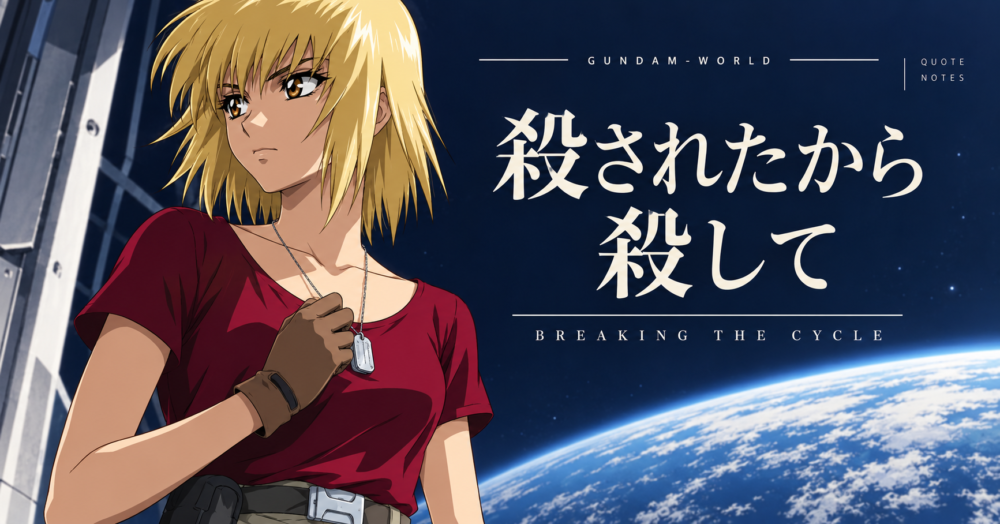
Cagalli’s “killing because someone was killed” exposes a cycle in which each death supplies the justification for the next. In Mobile Suit Gundam SEED, she challenges Athrun after he tells her that he has killed Kira. Her objection does not depend on treating grief as unreal. It asks whether grief can be allowed to make retaliation the only possible response.
Spoilers: Kira and Athrun’s battle, Athrun’s rescue and Cagalli’s conversation with him. The discussion follows what the characters believe at this point. English renderings are our translations for commentary, not an identified licensed dub or subtitle.
殺されたから殺して
Cagalli Yula Athha · Mobile Suit Gundam SEED; short excerpt
Korosareta kara koroshite — “Killing because someone was killed…”
What has Athrun told Cagalli?
The official story guide for “慟哭の空” describes Athrun being recovered by a rescue team, telling Cagalli that he killed Kira, and answering her grief with the claim that enemies have to be defeated. She later gives him a protective stone. The scene joins an argument about killing with an act that expresses concern for the person being challenged. Source: official story guide.
The episode is original TV PHASE-31 and the HD-remaster listing’s 29th installment. Athrun has his own losses and sees Kira through the role of an enemy. Cagalli knows another relationship to the same person.
The repeated word makes a chain audible
The short excerpt turns from passive to active: someone was killed, therefore someone kills. Kara supplies the “because,” the point at which a fact becomes a reason for another act. Repeating the verb lets the listener hear the mechanism rather than only the emotion that drives one person’s decision.
The longer thought continues the chain. Quoting the opening is enough to see why its rhythm matters: every apparent ending becomes another beginning of the same action. If each side can point to a death that came before, the reasoning can renew itself indefinitely. A demand for repayment offers no built-in point at which the accounts are finally closed.
Recognising grief is different from authorising revenge
Cagalli’s protest would lose force if it only told Athrun that he should feel nothing. The scene is more difficult because the pain is recognisable. He can care about someone who died and still have to answer for the next act. An explanation of why retaliation feels compelling does not automatically make it the only legitimate course.
Our reading is that she interrupts a slide between those two propositions. “I have been hurt” is a claim about an experience. “Therefore I must inflict the next hurt” is a decision. War encourages the second to sound like a simple consequence of the first. Her repetition exposes the connection as something people are still making, rather than a law that removes their agency.
What English has to supply
The Japanese leaves subjects unstated. That allows the sequence to move between people and sides without naming a fixed “we” and “they.” English can explain it as “They killed someone, so we kill someone,” but that version adds camps that the short wording itself does not specify. It can make the cycle clearer while making the accusation more narrowly assigned.
“Killing because someone was killed” is awkward as a finished sentence, but useful as a translation of the excerpt. It preserves the movement from a death received to a death inflicted. “An endless cycle of revenge” is a concise summary, not a literal replacement for the words. The difference matters because the original makes the listener work through the recurring action.
Why the protective stone belongs in the reading
The later gesture of concern prevents the confrontation from becoming only a verdict on Athrun. Cagalli objects to what he has done and the logic he offers, while still wanting him to live. In our reading, that is an enacted alternative to the chain: disagreement does not require her to withdraw every recognition of his humanity.
The scene does not settle the war. Its strength is personal: one person insists that another must not disappear entirely into the enemy’s role. That interruption of retaliation leaves the larger causes unresolved.
Three questions about the quote
Who is Cagalli talking to? Athrun, after his rescue and his account of the battle with Kira. The article follows their knowledge and feelings at that moment.
Is she saying grief does not matter? No. The challenge concerns what grief is used to justify, rather than whether loss can be painful.
Is “cycle of revenge” the literal Japanese phrase? It is a useful summary. The quoted wording instead repeats killing and its stated cause, making the chain audible.
Read Lacus on feelings and power for another attempt to connect care with action. Kira’s refusal to abandon the world and Amuro’s objection to imposed solutions address different ways an argument can make destructive force seem inevitable.
References: Mobile Suit Gundam SEED; official “慟哭の空” story guide; official 2012 cast-event report identifying the short line. Language and character analysis are our interpretation.
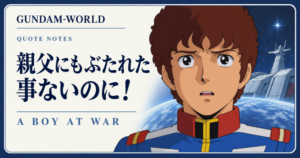
Featured image: original AI-generated fan illustration created for Gundam-World.






Comments