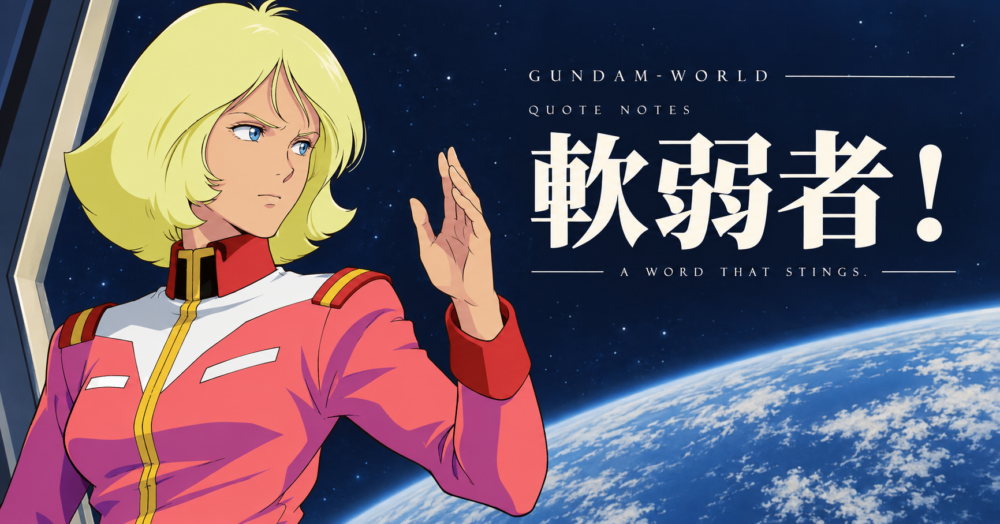
Sayla Mass’s “Nanjakumono!” means “Weakling!”—but in the episode it condemns Kai Shiden’s conduct, not his physical condition. The line occurs in episode 2 of the original Mobile Suit Gundam, during the evacuation crisis. A single harsh label makes her judgment of his reluctance to help unmistakable.
Spoilers: Sayla and Kai’s encounter in Japanese TV episode 2, “ガンダム破壊指令.” Their later outcomes are not explained. English renderings are our translations for commentary, not a transcript of a specific licensed dub or subtitle.
軟弱者!
Sayla Mass · Mobile Suit Gundam
Nanjakumono! — “Weakling!”
What is happening when Sayla says it?
The familiar moment involves Sayla, Kai and a slap as people are trying to evacuate. The official original-series quote feature identifies episode 2 and explains her rebuke in the context of Kai’s unhelpful response. It is an early impression of both characters, made while ordinary social life has been disrupted by an attack. Source: official quote feature.
The scene does not give either person a calm setting in which to explain themselves fully. Sayla judges what Kai is doing in front of her. Kai is reacting to an emergency that he did not choose. That collision of immediate need and personal reluctance gives a very short exchange more substance than the isolated slap or catchphrase can show.
Physical weakness is not the whole accusation
Nanjaku can describe weakness, softness or a lack of firmness; mono makes the expression a label for a person. A dictionary-level “weak person” therefore captures part of the construction. But here the scene directs the judgment towards behaviour under pressure. It is not a report on Kai’s strength, health or ability to lift a particular weight.
“Weakling!” preserves the compact insult. “Coward!” makes a moral accusation more explicit, but narrows the possible meaning towards fear and courage. “Spineless!” foregrounds a lack of resolve. The translator’s problem is choosing a word that sounds like a spontaneous rebuke while keeping the target of the complaint clear.
English also changes according to performance. A clipped “Weakling” can sound icy; a shouted “Coward” may sound like a challenge to act. The Japanese is only one word, so the voice and the surrounding action do much of the work. A bilingual comparison should leave room for that performance rather than imagining that one noun can carry every shade.
Why the label does not define Kai forever
A sharp first encounter is an efficient way to introduce a character, but it is not the same as a complete verdict on a life. Our reading is that Sayla’s word tells us what she demands at this moment and how quickly she is prepared to express disappointment. It also gives Kai an initial image that later choices can complicate.
That makes the encounter worth revisiting after watching more of the series. The interesting question is not whether every later action merely confirms the insult. Ask instead what changes when someone who was reluctant to help becomes involved, and whether the original judgment still seems adequate to describe him. A character’s development needs space to exceed a first impression.
What the scene reveals about Sayla
Her response is direct and unsparing. It sets a standard of participation: when others need help, she expects more than self-protection and complaint. That expectation gives her authority in the scene, but the audience can still question how she expresses it. Understanding her anger does not require treating a slap as the only possible way to make the point.
Keeping both parts visible helps avoid a familiar shortcut in discussing forceful women: turning every cutting line into either an untouchable expression of strength or an excuse to dismiss the speaker as unreasonable. Sayla is making a judgment in a specific crisis. The particular action, the need she sees and the way she reacts are more useful than either stock description.
Why one word survives in fan memory
The word’s brevity allows the scene to be recognised almost instantly. It joins a judgment, an action and a character introduction in one beat. What tends to disappear in repetition is the demand for help around it. Restoring that demand explains why “Weakling!” carries more than a general preference for tough people.
Three questions about the quote
Who does Sayla call “Nanjakumono”? Kai Shiden, in the original TV episode 2 encounter. It is not an accusation directed at Amuro in his argument with Bright.
Does it refer to a physical disability? In this scene, the rebuke concerns behaviour and resolve. A purely physical reading misses the context.
Is “Coward!” always a better translation than “Weakling!”? No. It clarifies one implication but narrows the wording; delivery and surrounding action matter to the choice.
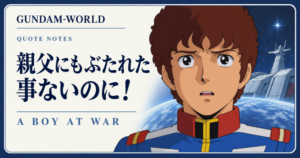
Compare Amuro’s protest after Bright strikes him to see a different conflict over behaviour in a crisis. Haman’s cutting rebuke gives contempt another register, while Ramba Ral’s “No Zaku” shows how a first impression can be built through a short line.
References: Mobile Suit Gundam, Japanese TV episode 2; official quote and scene explanation. Character and translation analysis are our interpretation.
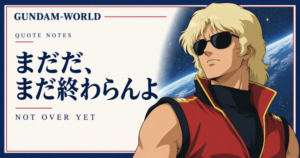
Featured image: original AI-generated fan illustration created for Gundam-World.





Comments