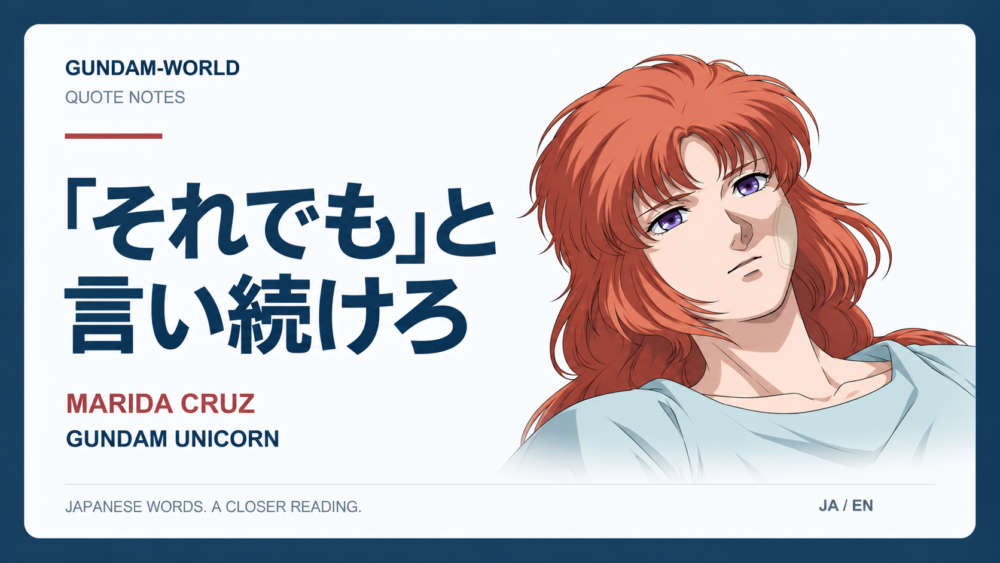
Marida’s “Keep saying ‘even so’” asks Banagher not to surrender his ability to answer the world’s apparent final verdict. The crucial wording is それでもと言い続けろ: she tells him to continue saying an expression, not to adopt every decision she might make. The advice in Mobile Suit Gundam Unicorn has a different focus from Banagher’s own repeated “even so”: it is about one person entrusting another with a voice.
Spoilers: the developing relationship between Marida and Banagher in Unicorn. This article discusses the advice without reproducing the complete surrounding speech. English renderings are our translations, rather than a licensed subtitle or dub transcript.
「それでも」と言い続けろ
Marida Cruz · Mobile Suit Gundam Unicorn; short excerpt
Romanization: “Soredemo” to ii-tsuzukero.
Our translation: “Keep saying “even so.””

The speaker matters as much as the phrase
The official profile introduces Marida as a pilot of the Sleeves and the Kshatriya. At first, the military roles around her and Banagher place them on different sides. Advice from her therefore disrupts a simple division into people who encourage him and enemies who only obstruct him. Source: official Marida profile.
Her relationship with him makes the command more than a piece of motivational language. It comes from someone whom the conflict could have reduced to a target. The possibility that she can understand and encourage him is already a small challenge to the idea that the present arrangement of enemies exhausts what people can become to one another.
What exactly is she telling him to continue?
Ii-tsuzukeru combines saying with continuing; ii-tsuzukero is its imperative form. The quoted soredemo is marked as what is to be said. That grammar matters: the instruction preserves an activity—responding—rather than dictating the content of every future judgment.
A natural English version is “Keep saying ‘even so.’” “Never stop saying ‘nevertheless’” stresses persistence but can sound more absolute and formal. “Keep believing” explains a likely implication, yet removes the act of speaking that the Japanese makes explicit. Marida asks Banagher to keep articulating a response, even when that response begins with only a connective.
“Even so” makes room after an acknowledged fact
Soredemo points backwards to a difficulty and opens what can follow despite it. It does not require pretending the difficulty is imaginary. A history of violence can be real without being a complete instruction for the next person’s action. The phrase permits the speaker to hear the objection and still refuse a closed conclusion.
That is why the advice is not the same as “say that everything is fine.” Its usefulness begins where things are not fine. A comforting denial would collapse when tested by another loss. “Even so” can survive the acknowledgment because it is a way of continuing after that acknowledgment, not a substitute for it.
A command that can protect another person’s agency
Marida uses an imperative, a strong grammatical form. Yet in our reading its object makes it unusual: she is urging Banagher to preserve his own response. An order can close a choice by supplying the only permitted action; this one can open a choice by refusing to let him abandon the act of answering.
That does not make all forceful advice automatically liberating. Tone, relationship and consequences still matter. Here the tension between the commanding form and the space it makes for another voice is precisely what rewards attention. She does not need to become a gentle, vague speaker for the encouragement to be generous.
Keep the recurring idea separate from one particular scene
The broadcaster’s synopsis places this advice in RE:0096 episode 8, “ラプラス、始まりの地.” Marida is a Federation prisoner, and her encouragement is linked to awakening another system inside the Unicorn. That concrete setting matters: this is not a response inserted after Full Frontal’s later political proposal. Source: Nagoya TV’s episode 8 synopsis.
The OVA and television re-edit divide the story differently. Within that difference, the speaker’s role remains clear: Marida gives the instruction; Banagher must make the next response. The value of the advice lies partly in the fact that she cannot perform that response for him. Her voice accompanies his effort without replacing it.
Three questions about the quote
Is Banagher the speaker of this instruction? No. Marida tells him to keep saying “even so”; his own uses of the expression are a related but separate act.
Does it mean ignoring every objection? No. The connective can acknowledge an objection while resisting the claim that it settles every possibility.
Which television episode contains the advice? The broadcaster identifies it in RE:0096 episode 8. That television number should not be copied directly onto the OVA’s different episode structure.
The companion article on Banagher’s “even so” examines the connective itself. Marida’s choice of family and her own heart and Zinnerman’s final order approach a different question: what happens when an instruction asks someone to choose for herself.
References: Mobile Suit Gundam Unicorn; official Marida profile and broadcaster’s episode 8 synopsis. The reading of encouragement, grammar and agency is this article’s interpretation.


Comments