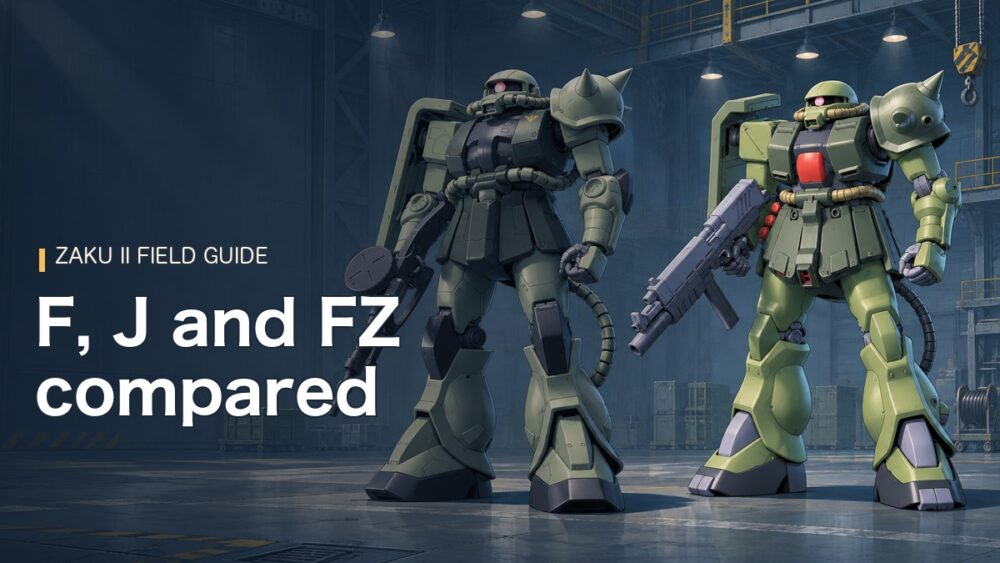
The mono-eye, right shoulder shield and spiked left shoulder identify a family. They will not by themselves separate an MS-06F from an MS-06J. Start with where each model was intended to operate. For the MS-06FZ, look at the centre of the chest, then the limbs; the shape of the helmet alone can mislead you.
| Designation | Role or series | Visual cue |
|---|---|---|
| MS-06F | General purpose, space capable | Can closely resemble J from the front |
| MS-06J | Ground use | Check box designation, backpack and soles |
| MS-06FZ | Final production type / 0080 | Red central hatch, changed limb armour and optional head types |
F versus J: a front view can leave the question open
The F-type is a general-purpose machine capable of space operations and also used on the ground. The J-type is the ground-use version. A Zaku standing on soil could be either. Green paint, a familiar shoulder shield or a machine gun make a convincing Zaku silhouette, but none is a reliable way to read that final letter.
One practical comparison is Bandai’s original 1:100 MG MS-06F/J. Its instructions distinguish the builds at the backpack and the sole thrusters. That makes the kit a particularly good demonstration: the same basic body can look very similar from the front while its equipment changes at the back. The separately sold MG Ver.2.0 kits label the variant on the box. Use the instructions for the actual release in hand when comparing the sculpt.
Why the Kai is easier to spot at the chest
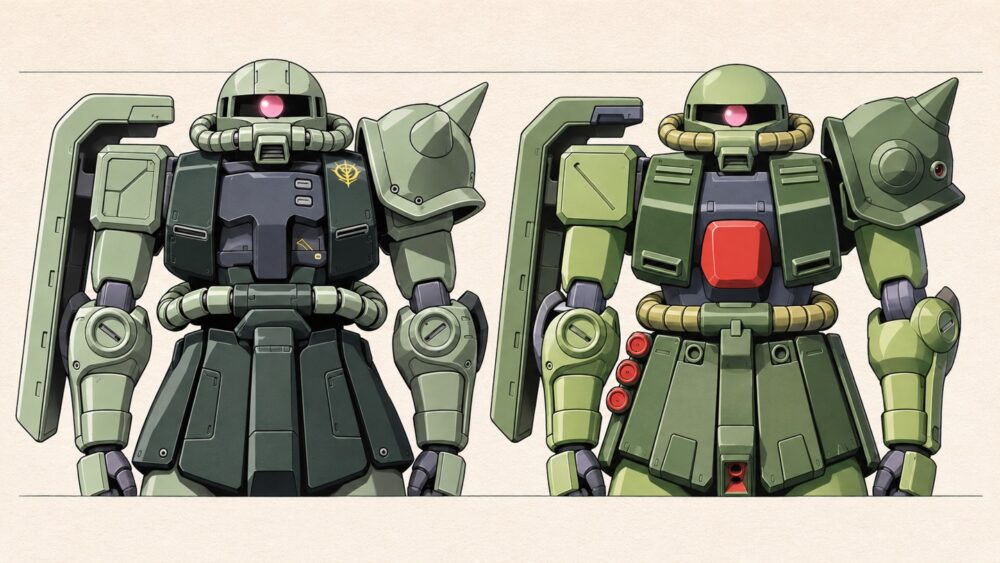
The MS-06FZ, or Zaku II Kai, is the final production type seen in War in the Pocket. Its red central cockpit hatch, the way the chest plates step around it, and the redesigned armour on the arms and legs give it a different silhouette. A three-quarter view that includes the torso and legs usually tells you more than a close crop of the eye slit.
The conventional head and the helmet-like alternative with a flared lower rim can both represent an FZ. Compare the optional heads in the HGUC and ROBOT SPIRITS releases. If the helmet rim is absent, look back to the chest. If all you have is an ambiguous headshot of a conventional Zaku II, it is reasonable to leave the exact designation open.
Choosing Bernie’s machine for a display
Bernard Wiseman fights the Alex with a Zaku II Kai inside a Side 6 colony. Choosing a ground-use J-type solely because you remember trees around the fight would give you the wrong model. To recreate the encounter, look for MS-06FZ on the box. To compare the F and J instead, two releases in the same grade and scale make their subtle differences easier to see.
A kit lets you see how the armour breaks into parts. A finished articulated figure makes it easier to compare the two head choices and an action pose. The shopping section pairs two 1:100 MGs and shows the Kai in both HGUC and ROBOT SPIRITS form. The latter is not sold on the same formal scale designation as the HGUC.
Compare Gunpla kits and ROBOT SPIRITS figures


Sources and related reading
- Bandai MS-06F/J kit manual
- Bandai HGUC Zaku II Kai
- ROBOT SPIRITS Zaku II Kai
- “Say Hi to Chris for Me”: Bernie’s Video Letter in Gundam 0080
- 200 Universal Century MS and MA Configurations Ranked by Spec
Product photos are advertisements from participating Rakuten retailers. Amazon buttons search by product name. Check the seller, contents and availability on the listing. As an Amazon Associate this site earns from qualifying purchases.



Comments