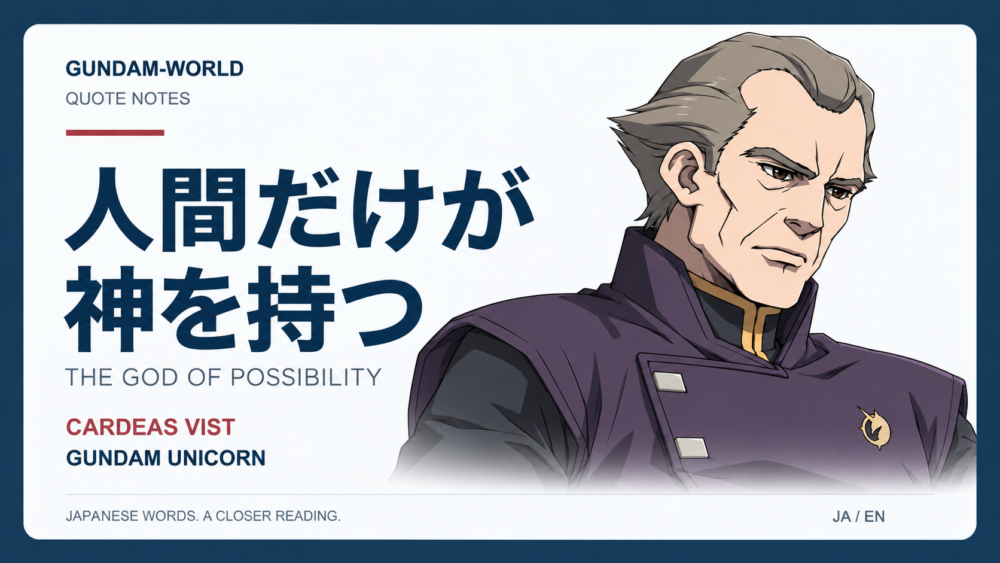
Cardeas Vist’s “Only humans possess a god” uses god as a metaphor for possibility—the capacity to reach beyond the present. It is spoken to Banagher in Mobile Suit Gundam Unicorn. The speaker is Cardeas, not Full Frontal. Reading the short opening together with its explanation avoids turning it into a detached claim about which species can practise religion.
Spoilers: Cardeas and Banagher’s opening relationship and the handover of responsibility in Unicorn. The later resolution of Laplace’s Box is not explained. English renderings are our translations, not a licensed dub or subtitle transcript.
人間だけが神を持つ
Cardeas Vist · Mobile Suit Gundam Unicorn; short excerpt
Romanization: Ningen dake ga kami wo motsu.
Our translation: “Only humans possess a god.”

Who is Cardeas speaking as?
The official profile identifies Cardeas as the head of the Vist Foundation, a man connected to the opening of Laplace’s Box and to the institutions surrounding Banagher. He is therefore not an uninvolved philosopher describing humanity from outside its political arrangements. The person praising possibility has himself occupied a position inside an inherited structure of power. Source: official Cardeas profile.
That makes the sentence a question of transmission as well as belief. Cardeas is addressing someone younger who will have to act after his words. The capacity he invokes cannot remain his private conviction if it is to matter. Another person must decide what to do with what has been passed on.
The explanation changes what “god” means
The continuation identifies an inner god called possibility and the power to go beyond the present. That definition directs the image towards a human capacity. It is not necessary to decide whether Cardeas is making a complete theological argument before understanding the function of the sentence in the story.
A “god” can suggest an authority beyond ordinary limits. Calling possibility an inner god relocates that authority: the opening is within people rather than arriving solely as an external rescue. In our reading, the metaphor makes the capacity to imagine and act beyond an existing arrangement feel momentous, without making it an already completed transformation.
What “ningen dake ga” stresses
Ningen is humanity or human beings; dake limits the statement to them. The subject marker ga gives the sentence its identification. English “Only humans…” preserves the limiting emphasis more clearly than “Humans have a god,” which could sound like a simple statement of belief.
Motsu means to have, hold or possess. “Possess” gives the English a formal weight; “have” sounds plainer. “Carry a god within them” makes the later image immediately legible, but adds “within” before the short Japanese opening itself states it. An explanatory article can show the brief translation first and then let the continuation define the metaphor.
Why capitalization cannot settle the interpretation
Japanese does not use the English distinction between lower-case “god” and capitalised “God.” Choosing one in English already nudges the reader towards either a general divine image or a particular theological-sounding authority. Here lower-case “a god” helps keep the phrase open until the explanation of possibility arrives.
That is a translation decision, not proof that a licensed version using different capitalization is mistaken. A performance, the surrounding sentences and the wider scene can carry information that a printed capital alone cannot. The useful comparison is how the translation guides the reader towards the metaphor the speech develops.
Possibility is not a guarantee of progress
A capacity can be abandoned, misused or left unrealised. The sentence becomes too easy if it is read as “humans will inevitably improve.” Cardeas is handing Banagher a reason to consider a future beyond the current order, not a schedule on which that future must arrive.
His own involvement in established power makes that distinction sharper. Invoking possibility does not erase what adults have preserved or concealed. It asks whether the next person must reproduce the same boundaries. The hope has weight because the answer remains something people can fail to make real.
A different voice from Full Frontal
Full Frontal’s measured account of human conduct can sound like the final limit of what is practical. Cardeas’s metaphor opens in the other direction: the present arrangement is not the full extent of human capacity. Neither voice should be substituted for the other simply because both speak about humanity in elevated language.
That contrast helps explain why the original speaker matters. The sentence belongs to an act of entrusting a future, with all the uncertainty that entails. It is not only an impressive standalone statement that can float free of the relationship between Cardeas and Banagher.
Three questions about the quote
Is Full Frontal the speaker? No. This statement is associated with Cardeas Vist addressing Banagher.
Does “god” simply mean organised religion? The continuation directs the metaphor towards possibility as an inner capacity to go beyond the present.
Does the line promise that humanity must improve? No. Possibility describes what could be realised, not what will happen automatically.
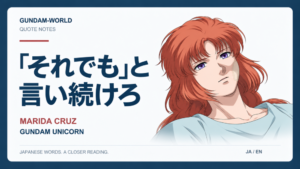
Read Banagher’s “even so” and Marida’s encouragement to keep answering for later forms of this question. Full Frontal’s advice about mistakes offers a distinct voice that should not be confused with Cardeas’s.
References: Mobile Suit Gundam Unicorn, opening Cardeas–Banagher sequence; official Cardeas profile. Language and metaphor analysis are our interpretation. See also the broadcaster’s Cardeas–Banagher handover synopsis for the scene context.

Comments