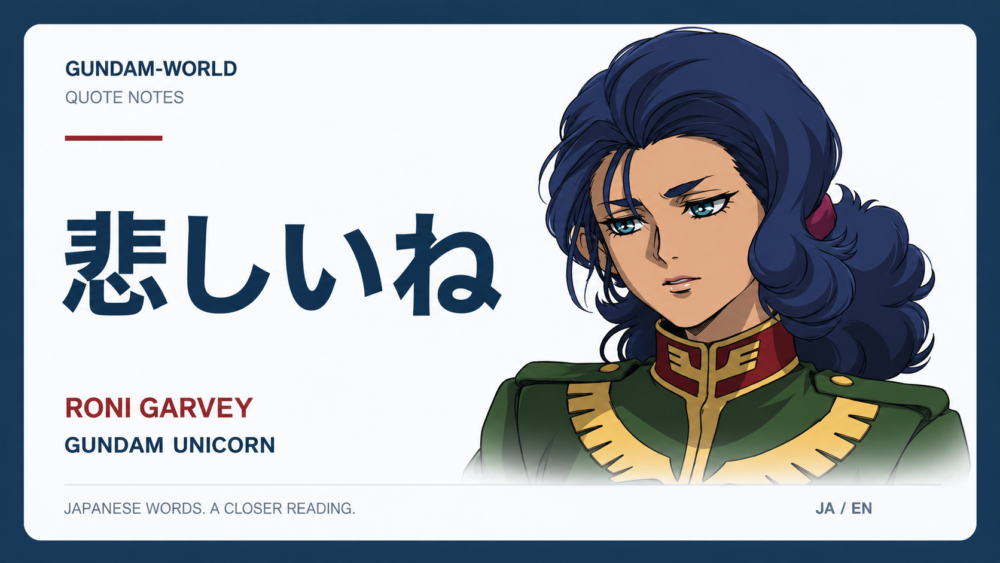
The line remembered as “Kanashii ne, Banagher” belongs to Roni Garvey, not Riddhe Marcenas. In Mobile Suit Gundam Unicorn, it is associated with the tragedy around the Shamblo at Torrington. “It’s sad, isn’t it, Banagher?” is our explanatory English rendering: the small ending ne reaches for shared recognition in the middle of a conflict that has made recognition difficult.
Spoilers: the Torrington battle in the animated Unicorn, including Roni’s fate. English quotations in this article are our translations of the Japanese, rather than transcriptions of a licensed English dub or subtitle.
悲しいね
Roni Garvey · Mobile Suit Gundam Unicorn; short excerpt
Romanization: Kanashii ne.
Our translation: “It’s sad, isn’t it?”
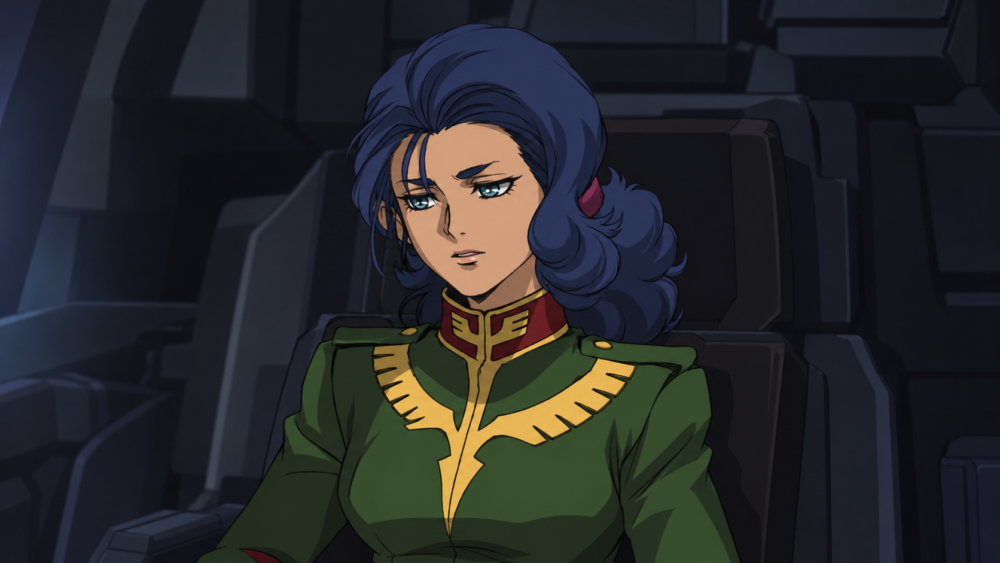
Who is Roni, and why is she fighting?
The official character profile identifies Roni as a Zeon-remnant pilot who operates the large mobile armor Shamblo. Her father’s death at Federation hands informs her desire for revenge. That background matters because the machine confronting Banagher contains a person with a history of loss, not an anonymous embodiment of destruction. Source: official Roni profile.
Her suffering does not remove the suffering caused by the attack. That is the difficulty Banagher faces: recognising another person’s pain and stopping the harm that person is inflicting are both urgent. A reading that treats Roni only as an innocent victim loses the people threatened by Shamblo. A reading that treats her only as a target loses the possibility that she can still be reached.
Why the speaker should not be confused with Riddhe
Riddhe belongs to the same dramatic sequence, but he and Roni occupy different positions within it. Attaching the expression to him changes whose grief we hear. The remembered wording addresses Banagher; it is not Banagher describing someone else’s sadness from a safe distance.
The familiar search phrase puts the feeling before Banagher’s name; scene accounts also give the address in the order “Banagher… it’s sad.” The search phrase is a convenient label, not a transcript of the pauses or word order. We quote only the short core “kanashii ne” here, preserving Roni’s voice without stitching the address into a different sentence.
What “kanashii” leaves unstated
Kanashii is “sad” or “sorrowful.” The short expression does not supply a single grammatical object for the sadness. That omission leaves the listener to hear the situation: loss, the inability to stop repeating it, and a moment of understanding that does not simply reverse what has happened.
English “I’m sad” places the feeling more firmly inside the speaker. “This is sad” points more firmly at an event. “It’s sad, isn’t it?” can keep some of the Japanese openness. None of those choices has to mean that Roni is asking Banagher to approve what she has done. Sharing an emotion and justifying an action are different acts.
The ending “ne” and a moment of shared feeling
In this context, ne seeks recognition or makes the feeling something the other person can share. It is not automatically a question requiring a spoken answer. English’s “isn’t it?” is one way to suggest that orientation, although it can sound more explicitly interrogative than the Japanese performance.
A softer “It’s sad, Banagher” may therefore work in another delivery. The choice depends on whether the translation needs to foreground appeal, acknowledgment or intimacy. What matters is that the sentence turns towards another person. The enemy has become someone whose response can matter.
What the meme removes
As a reaction phrase, “sad, Banagher” can be applied to an inconvenience or a disappointing result. Its brevity makes it portable. The original scene has a different scale: personal grief is caught in machinery, retaliation and a battle involving people who cannot all be saved by a single sympathetic gesture.
Our reading is that the line hurts because understanding arrives without an easy rescue. It would be comforting if recognising sadness guaranteed an end to violence. Unicorn allows the recognition to matter even when it cannot erase the outcome. Returning to Roni’s voice restores that tension.
Three questions about the quote
Is Riddhe the speaker? No. This expression is associated with Roni Garvey; Riddhe’s part in the surrounding battle should not replace her voice.
Does “ne” mean she is asking permission? Here it is better understood as inviting recognition of the sadness, rather than asking someone to authorise an act.
Can the novel and animation be described as one identical scene? No. The adaptations handle Roni differently; this article follows the animated Torrington context.
Continue with Cagalli’s challenge to retaliatory killing and Banagher’s “even so”. Both explore what remains possible after grief becomes a reason for another violent act.
References: Mobile Suit Gundam Unicorn, animated Torrington sequence; official character profile. The language analysis and reading of shared grief are our interpretation. See also the broadcaster’s Torrington-battle synopsis for the scene context.
Comments