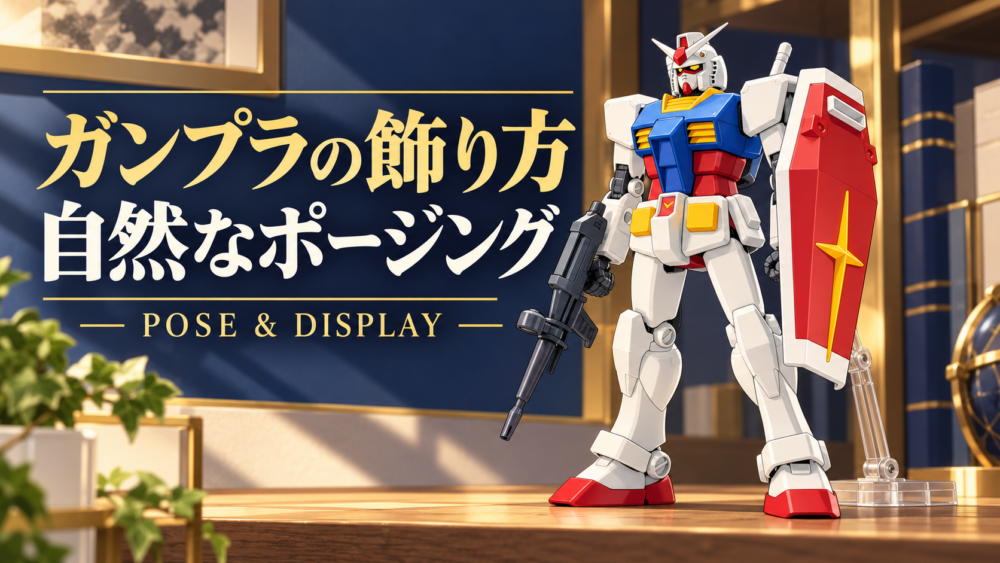
日本語:ガンプラの飾り方とポージング|棒立ちから自然に見せるコツ
Disclosure: This article contains affiliate advertisements. As an Amazon Associate, this site earns from qualifying purchases. The cover is an AI-assisted illustration created for this site.
Start a natural-looking Gunpla pose by checking that the feet are in contact with the surface and the model is stable. Then adjust the legs, hips, shoulders and head a little at a time. You do not need an extreme backbend or a raised foot to make a standing pose look intentional.
This guide concerns the presentation of a completed model. The diagram explains contact and balance; it is not a measured demonstration of a particular kit’s joint range or stand connection.
Check foot contact and balance first
Place both feet on a level surface. Spreading the legs while leaving the heels or toes lifted can make a pose less stable than it looks. Adjust foot direction, ankle angle and leg spacing together.
A backpack or large shield changes the balance from the unarmed model. Do not rely on a pose that stands only at the edge of falling over. Consider the actual shelf and the possibility of small vibrations or an accidental touch.
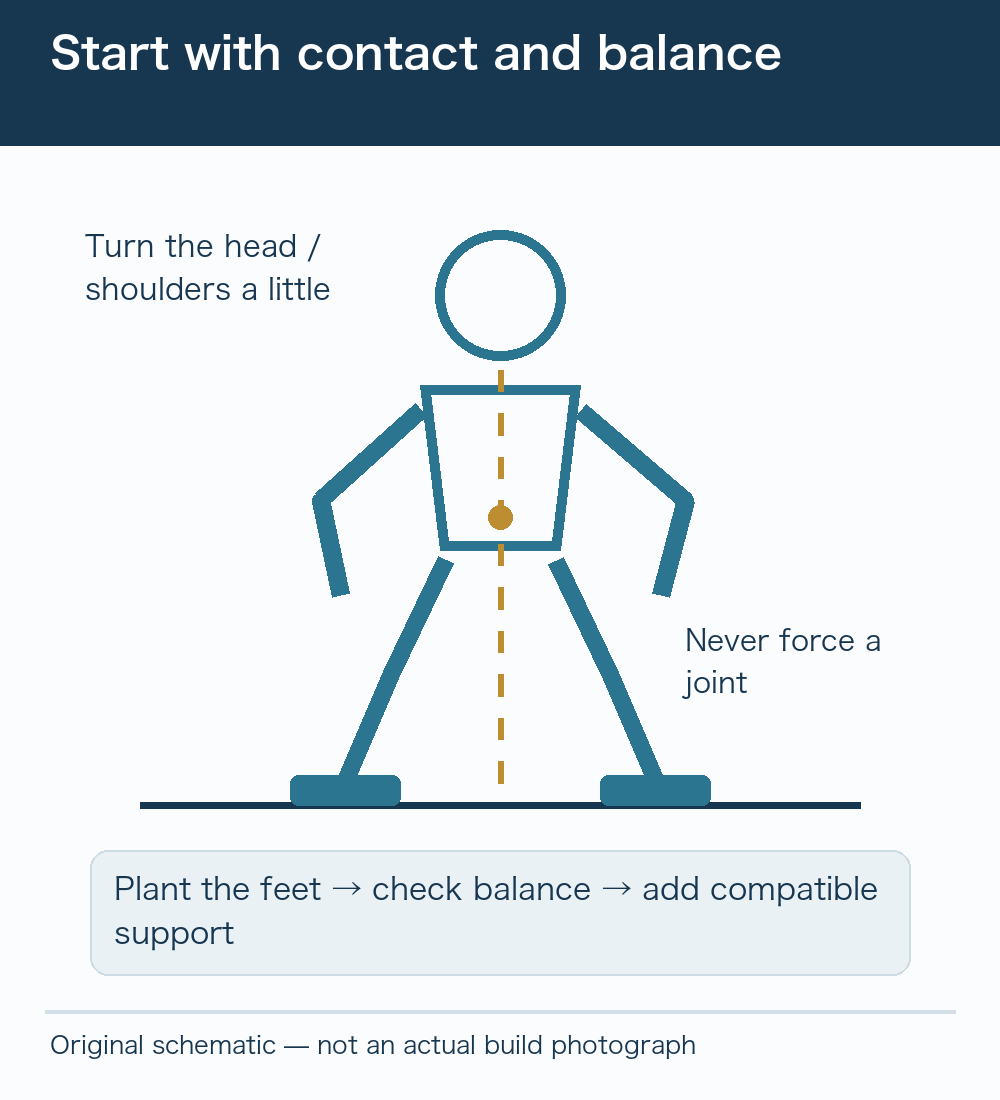
Adjust the legs, hips, shoulders and head in order
- Legs: try placing one foot slightly ahead while keeping the soles planted.
- Hips: a small difference between lower- and upper-body direction can suggest movement. Follow the individual kit’s articulation.
- Shoulders and arms: check whether the weapon arm and the opposite arm remain visible rather than disappearing into the torso.
- Head: turn it slightly toward the intended action. There is no need to force the chin into surrounding armour.
Change one area at a time so you can see what makes a difference. If a joint resists, investigate its direction and possible armour interference instead of forcing it through.
Give the weapon and gaze a common direction
For a shooting pose, check where the face, arm and rifle point. A weapon aimed sideways with the head facing straight ahead may communicate something different from the pose you intended.
For a beam-saber pose, decide whether the model is preparing a swing or finishing one. Arrange the torso and legs around that moment. Check that long weapons and effect parts stay within the shelf’s boundaries.
Use compatible support when the pose needs it
A floating pose or a major shift of the legs may need a stand. Check the kit’s mounting point, the supplied adapter and the supported area rather than forcing a visually similar connection. Added equipment can also change the balance.
Action Base 7 as a 1/144 support option
The manufacturer describes support for 1/144-scale models and includes two sets of bases and arms in the retail package. That does not guarantee every 1/144 model, equipment configuration or pose. Confirm the actual connection and balance of your model.
For a product comparison including larger models, see Action Base 7 versus 8. The purpose here is to develop the pose, rather than rank stands independently of the model.
Finish from your normal viewing angle
A model viewed directly on a desk looks different on a high shelf. Step back from its intended position and check that the face is visible and weapons do not obscure neighbouring models.
Clear supports can still be visible through their placement and reflections. Keep safe support as the priority, then adjust the presentation. If you will use a case, measure the finished pose’s complete width, depth and height before comparing it with usable internal case dimensions.
Frequently asked questions
Should I fix a stiff-looking pose by spreading the legs farther?
Not necessarily. Excessive spacing may lift the soles. Adjust the ankles, hips, shoulders and head along with the leg position to find a stable result.
Does every model need a stand?
No. A stable standing pose may be exactly what you want. Choose compatible support when you have a reason, such as a floating pose or an unstable configuration. For limited space, consider selective display and rotation storage as well.
More guides for building and displaying Gunpla
- Best First Gunpla: How to Choose Between EG and HG
- How to Build Gunpla: Instructions, Parts and Your First Straight Build
- Gunpla Nub Removal: Two Cuts, Sanding and Stress Marks
- Gunpla Display Cases: Measure the Kit, Weapons and Base First
- No Room for Gunpla? Small-Space Displays and Rotation Storage





Comments