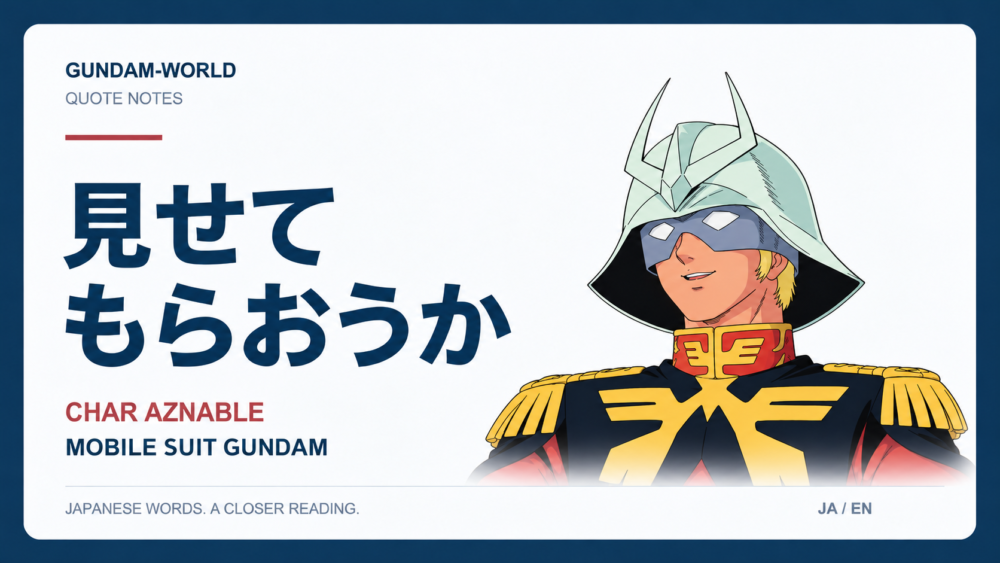
“Misete moraō ka” means roughly “Let me see,” and introduces Char’s challenge to the Federation mobile suit’s performance. The full short sentence is associated with episode 2 of the original Mobile Suit Gundam. It is an appraising remark from a pilot about to test an unfamiliar opponent, with a skeptical edge in to yara, rather than a polite request for permission.
Spoilers: Char’s early encounter with the Gundam; later outcomes are not described. English translations here are ours, not transcriptions of an identified licensed English release.
見せてもらおうか、連邦軍のモビルスーツの性能とやらを
Char Aznable · Mobile Suit Gundam
Romanization: Misete moraō ka, Renpōgun no mobiru sūtsu no seinō to yara wo.
Our translation: “Let me see what that Federation mobile suit can do.”

Which episode is the origin?
Bandai’s official dialogue-item announcement reproduces the expression and identifies it with episode 2. That early placement matters: Char is assessing a machine whose capabilities have not yet become routine knowledge to him. The remark is part of testing the opponent, not a retrospective statement made after a long rivalry has already supplied every answer. Source: official dialogue-item announcement.
The line positions Char as the evaluator. He does not begin by admitting anxiety about an unexpected Federation weapon. Instead, he speaks as though the machine has presented a claim and he will now see whether it can support that claim. The calm form is one of the ways the character makes uncertainty look manageable.
What does “misete moraō” actually do?
Misete comes from “show,” while morau frames the speaker as receiving the action. The volitional form moraō gives a sense of “let me have it shown” or “let us see.” A literal word-for-word version would sound awkward in English. The natural short form “Let me see” preserves the speaker’s decision to observe and judge.
The final ka need not be heard as an earnest question waiting for the opponent’s consent. In this context the remark can be directed partly to himself. He is setting up an encounter and describing the attitude with which he approaches it. A translation that sounds excessively courteous would miss that confidence.
The skeptical flavour of “to yara”
Seinō means performance or capability. The following to yara can distance a speaker from a description or something allegedly important: “this performance of theirs,” “these capabilities I hear about,” or, more sharply, “so-called capabilities.” Its exact strength depends on delivery and context.
English “so-called” can sound as though Char has already decided the machine is worthless. That may overstate the verdict. He is about to test it. “Let’s see what it can do” keeps the encounter open, but softens the skepticism. Commentary can explain the distancing expression alongside a natural translation instead of forcing every shade into one sentence.
A machine’s specifications and a pilot’s performance
The sentence explicitly names the mobile suit’s performance. Yet what Char can encounter in battle is a machine being operated by a person. The resulting action does not arrive as a clean laboratory measurement. Reaction, judgment and the unfamiliar pilot’s choices become part of what “what it can do” looks like.
That is a useful tension for a rewatch. Char may frame the meeting as an equipment appraisal, while the story is also introducing a relationship between pilots. Treating the line only as a specification challenge would miss why the encounter can surprise him even when the weapon itself is impressive.
Why the opening is so easy to reuse
“Let me see” can introduce almost any proposed skill, device or result. The open structure gives the remark a long life as a parody template. An official coffee collaboration, for example, adapted the recognisable structure to work performance. That is a new promotional line, rather than another original Gundam scene. Source: official collaboration announcement.
The joke works because the borrowed tone implies a grand evaluator assessing an everyday task. Returning to the episode restores the real uncertainty underneath the style. Char’s confidence is memorable because there is something he does not yet know and an opponent who can answer through action.
Three questions about the quote
Is “Misete moraō ka” the whole sentence? It is the widely reused opening. The original continues by naming the Federation mobile suit’s performance.
Is Char asking nicely for permission? The grammar can receive an action, but the scene’s force is an assured challenge and appraisal, not a deferential request.
Does “to yara” mean he already knows the Gundam is weak? No. It distances him from a claim; the upcoming encounter is still a test.
Compare Ramba Ral’s “No Zaku” for a pilot making the machine’s difference explicit. Amuro’s “Nu Gundam isn’t just for show” later makes a machine’s name answer an even greater demand.
References: the official quote and episode attribution and later promotional adaptation. Language and character analysis are our interpretation.

Comments