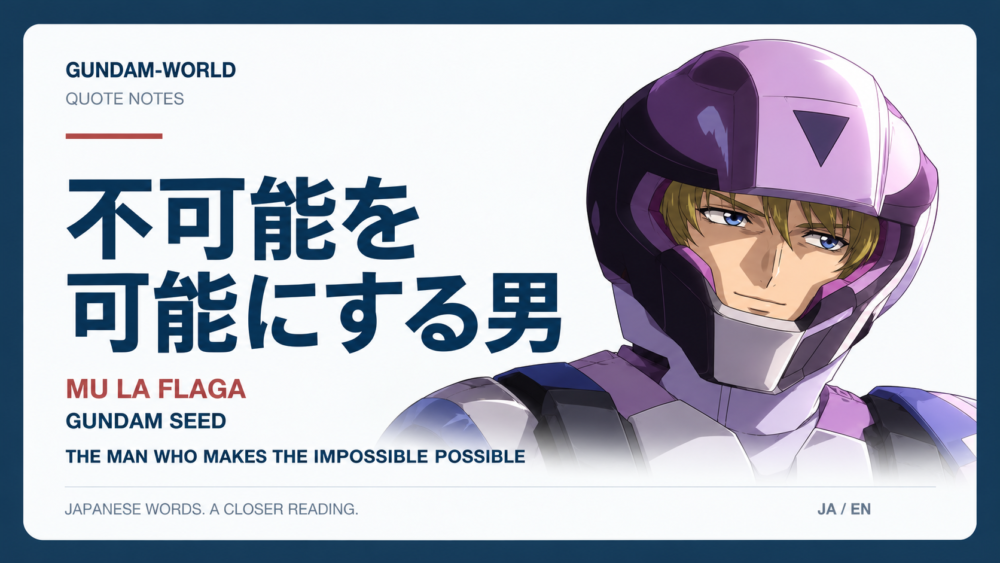
“The man who makes the impossible possible” is Mu La Flaga’s confident self-description in the SEED series. 不可能を可能にする男 is a compact way of announcing that he can find a way through a situation others have already called hopeless. Its appeal is not only that he is skilled. The relaxed boast lets frightened companions hear confidence from someone prepared to act.
Spoilers: Mu’s protective role in Gundam SEED and the broad survival-and-identity connection with SEED Destiny. Exact outcomes of later battles are not retold. English wording below is our translation, not a licensed dub or subtitle transcript.
不可能を可能にする男
Mu La Flaga · Mobile Suit Gundam SEED series; short phrase
Romanization: Fukanō wo kanō ni suru otoko.
Our translation: “The man who makes the impossible possible.”

A boast tied to a dependable role
The official character profile introduces Mu as an ace mobile-armor pilot who continues alongside Kira and the Archangel group, becoming an older-brother figure. That role helps explain why his confidence can feel reassuring rather than merely self-advertising. The person making the boast is also someone the younger characters repeatedly need. Source: official Mu profile.
A more solemn declaration might draw attention to the magnitude of the danger. Mu’s casual manner often does the reverse: it makes finding a way forward sound like the kind of thing he does. The lightness is part of the service he provides. He can give others a moment in which to think and act without having to carry his fear as well as their own.
How the Japanese turns a limit into an action
Fukanō is “impossible”; kanō is “possible.” The shared sound makes the contrast unusually tight. The construction A wo B ni suru means making A into B. What first appears as a final classification becomes material for an act of transformation.
Otoko, “man,” then makes the phrase a self-image: this is the kind of person speaking. “I make the impossible possible” is direct English. “I’m the man who makes the impossible possible” preserves the showier presentation of a persona. Neither sentence should be treated as a guarantee that physical limits cease to exist around him.
Why it should not be reduced to his last SEED battle
The phrase is remembered alongside Mu’s decision to protect the Archangel from a devastating attack. The official PHASE-49 guide describes his Strike putting itself in the path of the Dominion’s Lohengrin blast. That association gives the boast a cost: the person who says he can find a way does not merely instruct others to take a risk. He puts his own action between the threat and the people behind him.
But a character’s recurring self-description is not identical to one final utterance. Quoting the whole polished phrase as an exact uninterrupted deathbed sentence can mix separate moments. The point here is the expression and the way later action changes how an audience hears it, rather than a recreated transcript of one release.
What SEED Destiny adds to the memory
The later series revisits Mu through questions of survival, recognition and identity. That gives a familiar boast another function: wording associated with a person can help an audience hear the continuity of that person. A sentence that once announced capability can become a trace of someone remembered.
Our reading is that this is why the phrase remains emotionally useful beyond a simple nickname. It can carry the companions’ confidence, the burden of a protective action and the recognition of a familiar voice. Those meanings accumulate; they do not require every occurrence to have exactly the same tone.
Confidence is different from invulnerability
The phrase works because a limit seems real before Mu challenges it. If every danger were automatically harmless to him, there would be little generosity in taking it on. A compelling reading preserves uncertainty: confidence becomes something he offers to the group while the outcome remains at stake.
That also prevents the line from becoming a rule that everyone must always exceed their limits. In the story, it belongs to a particular pilot’s persona and decisions. Its dramatic value is the relationship between the easy words and the hard action, not an obligation placed on whoever happens to hear it.
Three questions about the quote
Is it a formal military title? No. It is a boastful self-description associated with Mu, distinct from an official rank.
Does it appear only in one fatal scene? The phrase is a recurring part of how the character is remembered; a particular scene’s exact wording needs its own edition check.
What makes the Japanese memorable? The near-matching fukanō and kanō turn the negative limit into a positive possibility within one compact construction.
Read Lacus on feelings and power for another SEED view of what makes ability meaningful. Amuro’s trust in Nu Gundam similarly makes confidence matter through an attempt to protect people.
References: Mobile Suit Gundam SEED and SEED Destiny; official character profile; official cast-event report and PHASE-49 story guide. The reading of confidence and recognition is our interpretation.
Comments