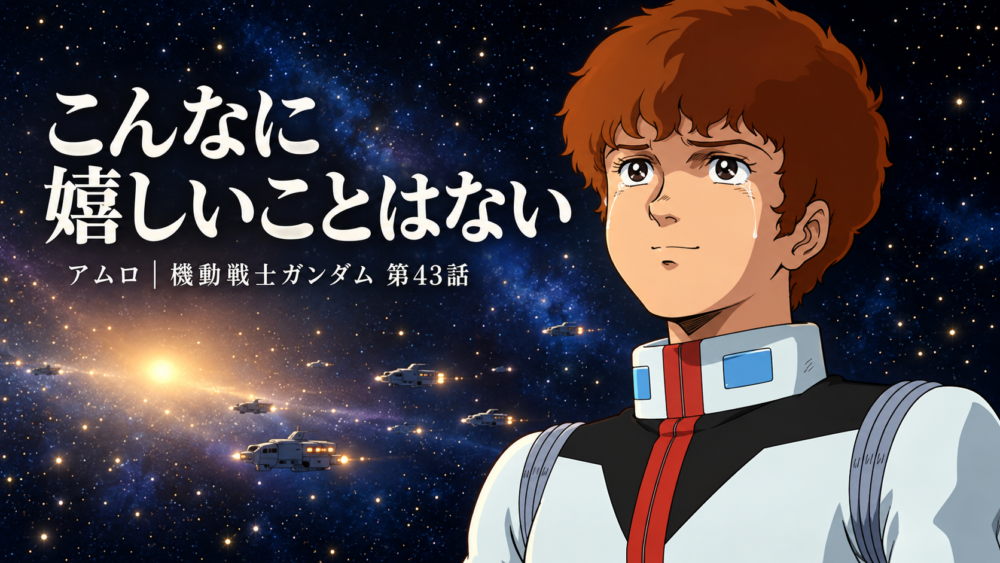
“Nothing could make me happier” is Amuro Ray’s famous homecoming line in episode 43, “Escape,” the final television episode of Mobile Suit Gundam. Having escaped A Baoa Qu, he recognises that he has people to return to: the White Base crew. The joy is not a boast about defeating an enemy, but relief at having a place among the living.
- Series / speaker
- Mobile Suit Gundam / Amuro Ray
- Episode
- TV episode 43, “Escape”
- Situation
- After the final battle, Amuro finds his way back toward his surviving friends.
- Related ideas
- A place to return to, and his words addressed to Lalah.
The English title is an explanatory rendering of the Japanese line, not a guarantee of one particular subtitle version. Its emotional force comes from the journey that makes an ordinary word like “happy” feel earned.
What happens in the final episode?
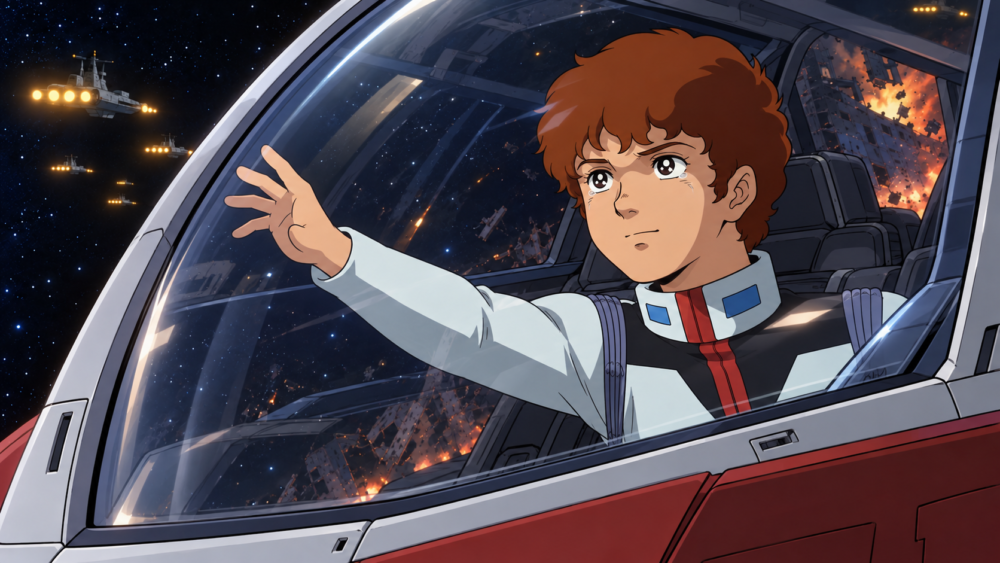
The last battle strips away places that seemed secure: neither a mobile suit nor a warship can promise safety. Amuro and Char confront each other outside their machines, while the crew’s escape and Amuro’s own survival remain uncertain.
The ending is therefore not simply a pristine hero robot posing over a defeated enemy. Amuro returns toward people who have survived and who want him back. The official final-episode synopsis follows that movement through the crew’s escape and the Core Fighter’s emergence to his discovery of somewhere to return.
A place to return is more than an address
The early Amuro is an isolated, technically gifted boy, not an effortless member of a team. Life aboard White Base brings conflict as well as companionship. Read against that beginning, his recognition of a home among other people represents a real change.
The place in this scene need not be reduced to a building, military unit or postal address. People are looking for him and hoping that he is alive. He can accept a place in that circle. This is an interpretation of the scene, rather than a technical definition from a setting manual.
How do his words to Lalah fit?
The ending also preserves his connection with Lalah. It does not ask him to erase someone he has lost before returning to those who are still alive. That tension is part of what gives the scene its tenderness.
It would go further than the scene supports to turn the line into a complete rulebook for the afterlife. A more careful reading is that he carries the connection with him while choosing to return to his living companions.
Television finale or movie III?
This article uses TV episode 43 as its reference. The movie trilogy is edited differently; if you want its concluding film, look for Encounters in Space. Do not use a film’s chapter position as though it were a TV episode number.
Amuro’s later appearance in Char’s Counterattack is another period of his life. The “light of the human heart” and the end of the original series can be read together, but they are not one scene and should not share the wrong costume or mobile suit.
Related merchandise: Amuro, the RX-78-2 and the finale
An Amuro figure or plush foregrounds the person; an RX-78-2 kit offers the machine; a video release lets you return to the story. Last Shooting merchandise connects with the final battle, but not the exact moment of this spoken line.
EG, HG and RG are distinct kit ranges, even when the mobile suit name matches. A Nu Gundam is not the machine from the original television finale. The cards below present related products rather than claiming that every item prints the quote.
Read Amuro’s story from other points
“It moves!” in episode 1 · “Amuro, launching!” · The light of the human heart
Sources
PR: This article contains affiliate links. As an Amazon Associate, this site earns from qualifying purchases. Product photos are supplied through authorized Rakuten advertisements; Amazon listings have separate terms. Stock and prices may change.
Comments