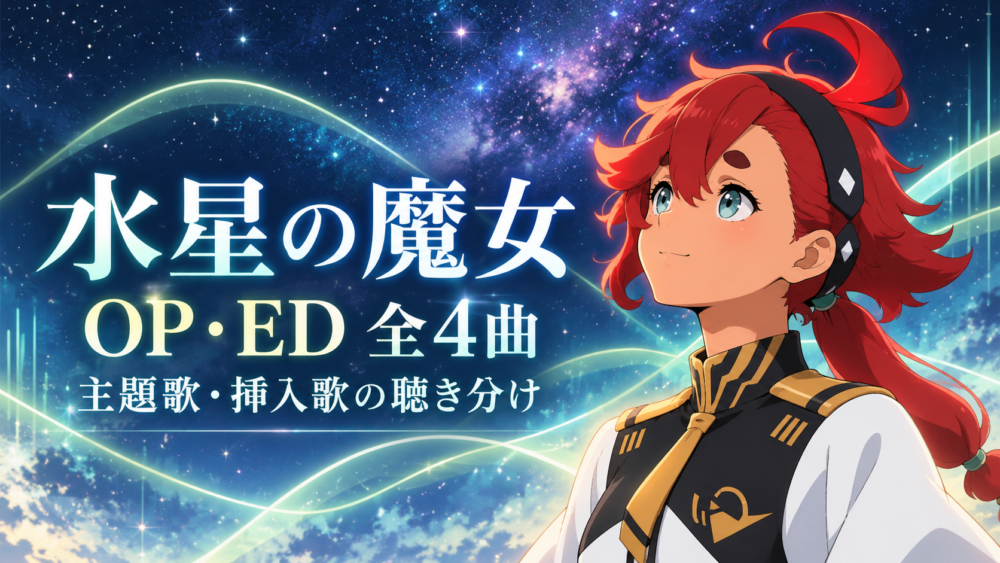
Mobile Suit Gundam: The Witch from Mercury has four regular television opening and ending themes across its two seasons. The finale’s “Houseki no Hibi” belongs in a separate insert-song category, which also matters when choosing a soundtrack.
| Role | Song | Artist |
|---|---|---|
| Season 1 opening | Shukufuku / 祝福 | YOASOBI |
| Season 1 ending | Kimi yo Kedakaku Are / 君よ 気高くあれ | Shiyui |
| Season 2 opening | slash | yama |
| Season 2 ending | Red:birthmark | AiNA THE END |
This is a table of regular theme assignments, not a claim that every episode uses the same track in the same place. The videos below are artist uploads, not reproductions of lyrics or animation clips by this site.
Season 1 opening: YOASOBI’s “Shukufuku”
“Shukufuku,” also known in English as “The Blessing,” is the first season’s opening theme. Search the artist and song together to distinguish the original Japanese performance from an English-language version or a live recording.
The energetic movement of the song can be heard alongside Suletta’s developing sense of direction. That is a suggested reading, not a claim that the lyrics have only one correct interpretation.
Season 1 ending: Shiyui’s “Kimi yo Kedakaku Are”
Shiyui performs the regular first-season ending. The official announcement placed its initial ending-theme appearance in episode 2. A song heard at the end of the premiere should therefore not be used to identify the regular ending assignment for the entire season.
The following is the artist’s original music video. A later rearrangement or live version should not automatically be treated as the same recording heard in the television broadcast.
Season 2 opening: yama’s “slash”
The second-season opening is “slash” by yama. The season label is the clearest way to separate it from YOASOBI’s earlier opening when searching for a song remembered from the series.
An artist music video and a creditless anime opening are different videos even when they share the song. The embed here is the official artist music video.
Season 2 ending: AiNA THE END’s “Red:birthmark”
“Red:birthmark,” including the colon in the title, is the regular second-season ending. It should be distinguished from the special insert song associated with the final episode.
A full music video, a live performance and the shorter television edit have different contents and durations. Check which version a product or streaming release actually provides.
The finale’s insert song: “Houseki no Hibi”
AiNA THE END’s “Houseki no Hibi” / 宝石の日々 is officially identified as an insert song for episode 24, the finale. It is not another title for “Red:birthmark” and is not a fifth regular opening or ending.
If you are trying to identify the song heard in the finale, this official artist upload provides a direct way to check it without a detailed plot summary.
Regular themes, special uses and score music
| What you want | Where to look |
|---|---|
| The four seasonal themes | The opening table |
| Houseki no Hibi | The finale insert song |
| Music under dialogue or action | The score / Original Soundtrack track list |
| A cue from PROLOGUE | That production’s credits, separately from the two seasons’ regular themes |
The score cue “The Witch From Mercury,” for example, is not a fifth opening simply because its name resembles the series title. Premiere and finale exceptions also mean that a season-level table should not be used to reconstruct every episode’s music placement.
Does the soundtrack contain the full theme songs?
The standard four-CD Original Soundtrack below is SRML-1055–1058. Its track list contains the four themes in television or anime edits: “Shukufuku” in Anime Edit form, “Kimi yo Kedakaku Are” in TV Size, “slash” in Anime Ver., and “Red:birthmark” in TV size.
It is therefore not an album containing all four full-length singles. “Houseki no Hibi” is not included in this standard edition’s listed tracks. For that song or full-length themes, check the artist’s separate single or digital release.
The standard CD edition, first-press limited edition and vinyl edition are different products. Old launch bonuses should not be assumed to remain available with a current listing.
Read alongside the characters’ words
The music can take on a different emphasis after revisiting Suletta’s “gain one, gain two” phrase. The relationship between a theme and a character is open to interpretation; it is different from the factual question of which season commissioned the song.
Comments