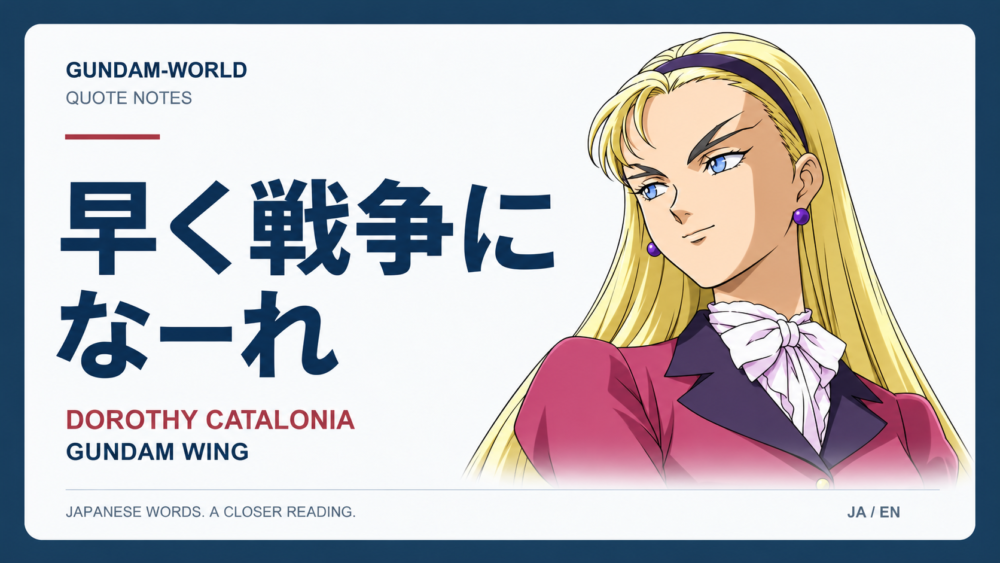
“Hayaku sensō ni nāre” is Dorothy Catalonia’s wish for war to come soon in Mobile Suit Gundam Wing. It is not a declaration by Relena, whose commitment to pacifism forms an important contrast. “Let war come soon!” is our explanatory translation: the disturbing feature is the light, wish-like form attached to something that will destroy people’s lives.
Spoilers: Dorothy’s attitude to war, her background and the conflict with the Sanc Kingdom’s pacifism. Her final encounters are not retold in detail. English renderings are our own, not an identified licensed dub or subtitle.
早く戦争になーれ!
Dorothy Catalonia · Mobile Suit Gundam Wing
Romanization: Hayaku sensō ni nāre!
Our translation: “Let war come soon!”
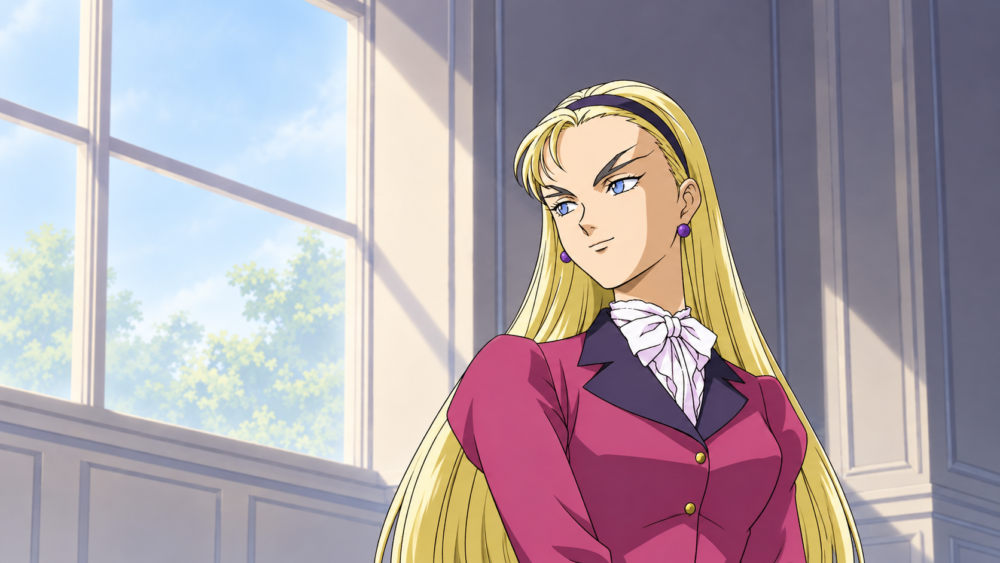
Dorothy and Relena should not be merged
Both characters belong to the political world of Wing, but the distinction between their voices is essential. Relena’s language argues for a world in which people refuse war as the means of settling disputes. Dorothy’s provocation puts pressure on the belief that such a refusal can remain intact when confronted with the desire and machinery for conflict.
Giving Dorothy’s wish to Relena would turn a contrast into a contradiction inside the wrong character. It would also remove Dorothy’s particular challenge: she can speak about war in a way that makes others reveal what they believe peace requires. The sentence is disruptive partly because someone says it aloud where such a desire should be unacceptable.
A wish that sounds almost playful
Hayaku means “soon” or “quickly.” Sensō ni naru means becoming a state of war. The form nare can make the change an imperative or a wish. Drawing out the vowel in nāre gives the line an almost chant-like quality, as though the desired change could be summoned by saying it.
English “Hurry up and start a war!” makes the demand forceful, but also suggests someone being told to initiate it. “Let war come soon” keeps the impersonal wish closer. “I hope a war starts soon” clarifies the speaker’s desire while losing the incantatory movement of the Japanese. Tone decides much of the horror in each version.
The phrase does not become harmless because it sounds light. In our reading, the mismatch is its central device. A familiar form used for a wish or a game carries a catastrophic object. The audience has to confront the distance between the ease of wanting the event and the experience of living through it.
Why “she simply loves war” is incomplete
The official character profile connects Dorothy’s involvement in war with the loss of her parents, and describes hatred and sadness beneath that involvement. It therefore supports a more complicated reading than a sheltered observer who has never had anything taken from her. Source: official Dorothy profile.
That background explains the contradiction without making every action wise. A person can hate what war has done and still be drawn towards making the whole world confront it. Grief can become an argument that more catastrophe is needed before anyone will change. The prospect of understanding the motive does not remove the cost to people who would have to endure that catastrophe.
The challenge to complete pacifism
Dorothy’s provocation asks whether a commitment to peace can survive people who do not share it. Relena’s position, in turn, asks whether deliberately intensifying war can escape the logic that keeps producing it. Treating either side as a one-line answer misses why their coexistence in the story matters.
Our reading is that the disturbing wish opens a question rather than supplying a safe solution. Can a person force others to understand war by giving them more of it? Who has the right to decide that another person’s suffering will be instructive? Those questions connect the playful delivery to the seriousness of the political conflict.
A memorable introduction is not a whole biography
The line is often used as shorthand for Dorothy’s entire personality. It is certainly an efficient first impression. But the series gives that impression a history and later tests it through relationships. Revisiting the phrase after learning that history can make the voice sound less like empty excitement and more like a deliberately troubling way of speaking through grief.
That change in hearing does not require pretending that the words originally meant peace. They still wish for war. The deeper context shows why the wish is conflicted, not why a destructive statement should be translated into its opposite.
Three questions about the quote
Is it Relena’s line? No. The speaker is Dorothy Catalonia; Relena’s pacifism is part of the contrast that makes the expression significant.
Does the elongated “nāre” change the basic wish? It colours the delivery, adding a chant-like or playful sound, while the desired event remains war.
Is Dorothy merely ignorant of wartime loss? The official profile gives her a history of loss and grief. That complicates her fascination without making the wish harmless.
Compare Kamille’s rejection of combat as amusement and Cagalli’s response to retaliatory killing. Heero’s first threat to Relena provides another example of Wing unsettling an ordinary conversational expectation.
References: Mobile Suit Gundam Wing; official Dorothy profile. The interpretation of the wish, its grammar and its political challenge is ours.





Comments