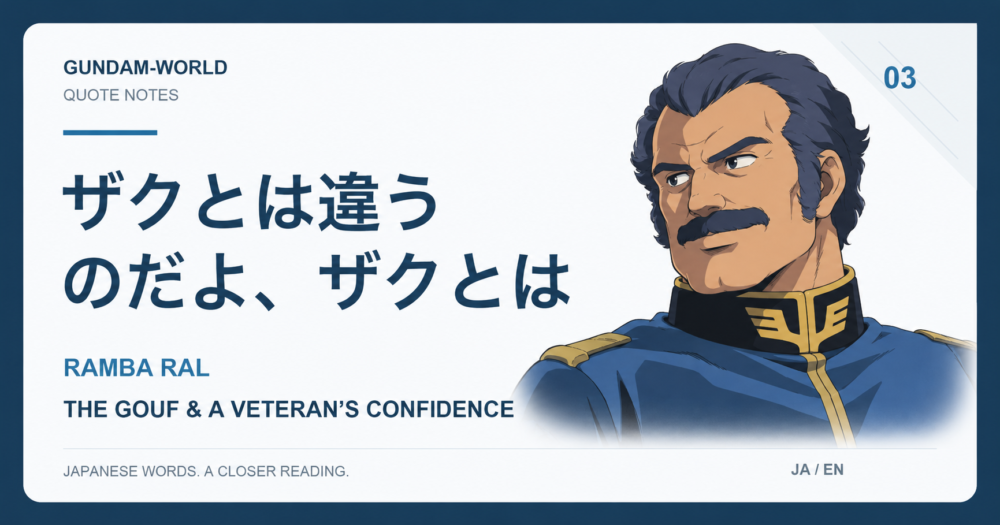
Ramba Ral’s famous “No Zaku” line says that the mobile suit he pilots, the Gouf, is different from a Zaku. It belongs to episode 12 of the original Mobile Suit Gundam television series. The Japanese makes that distinction twice, turning an identification into a confident warning.
If you searched for “This is no Zaku, boy,” this essay explains the Japanese behind the phrase. The English renderings below are our translations; we do not assign that familiar wording to a specific licensed dub or subtitle without an edition we can verify.
The original line and its source
ザクとは違うのだよ、ザクとは!
Mobile Suit Gundam; Japanese dialogue
Our translation: This is different from a Zaku. Different from a Zaku!
STRICT-G’s official Famous Lines page attributes the quotation to Ramba Ral and TV episode 12, ジオンの脅威. The BANDAI HOBBY Gouf kit manual provides an official reference for the machine and its association with Ral. The mobile suit being distinguished here is the Gouf.
Why “zaku to wa” comes twice
In this construction, to marks what something differs from, while wa highlights the contrast. Chigau is “to differ” or “to be different.” Ral is not merely announcing a new model name: he is directing attention to the comparison his opponent should stop making.
The repeated Zaku to wa arrives after the main statement. That return gives the comparison another beat of emphasis. A translation that keeps only “This is a Gouf” would communicate the label, but drop the shape of the warning. Repetition lets us hear Ral insisting that experience with one machine does not settle what will happen against another.
No da yo contributes an explanatory, assertive finish. In this context it can sound like a veteran setting someone straight. It is not a grammatical guarantee that the speaker is older, wiser or correct. Those impressions come from the way Ral’s established presence and the sentence work together.
A machine distinction and a pilot’s confidence
The simplest factual answer is the Gouf, rather than a Zaku. The more interesting dramatic answer is the confidence with which Ral makes that distinction. Our reading is that he presents his opponent with a lesson: do not assume that a familiar outline means a familiar fight.
We should resist inflating the boast into a universal technical ranking. This sentence does not prove that a Gouf wins in every environment or that every Gouf pilot surpasses every Zaku pilot. It is speech delivered inside a particular encounter. Keeping that boundary intact preserves the drama, because a character’s confidence is not the same thing as an encyclopedia’s conclusion.
It also helps explain the line’s appeal to model builders. Recognizing a machine means looking past the first resemblance and paying attention to its particular identity. That is our connection between the dialogue and the pleasure of looking closely at a kit; it is not a new performance claim about the fictional machines.
Does the Japanese actually say “boy”?
No word meaning “boy” appears in this Japanese sentence. English can make an implied relationship between speakers explicit through a form of address, but that addition should be identified as a translation choice. This is a useful contrast with Char’s bouya dakara sa, where a word for “boy” really is present.
A freer rendering of our own is “You are not facing a Zaku. Not a Zaku!” It keeps the repetition and makes the warning more immediate, while changing the sentence structure. Our more literal version above makes the comparison easier to study, but is less natural as spoken English. The purpose of each version should be clear.
Official merchandise also uses English: a GUNDAM.INFO report on STRICT-G clothing reproduces wording printed on a Gouf design. That is evidence for that product’s lettering. It does not, by itself, establish which subtitle or dub a viewer will hear on a particular release.
Quick questions
Who says the No Zaku line?
Ramba Ral, in the original Mobile Suit Gundam TV series. The episode reference above identifies episode 12.
Is the blue machine just a recolored Zaku?
The machine associated with this quotation is the Gouf. The line’s dramatic point is precisely that Ral rejects treating it as the same thing as a Zaku.
Why do the final words repeat?
The repetition reinforces the contrast and the warning. Dropping it can make an English version more economical, but also remove part of Ral’s distinctive rhythm.
More Gundam quotes to read closely
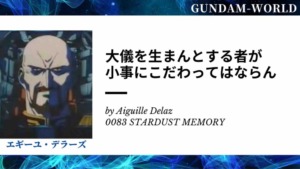
Compare these different voices: Full Frontal on mistakes and adulthood, Durandal on conflict and power, and Delaz on a great cause and small matters. Each essay separates the Japanese wording from our interpretation and translation.




Comments