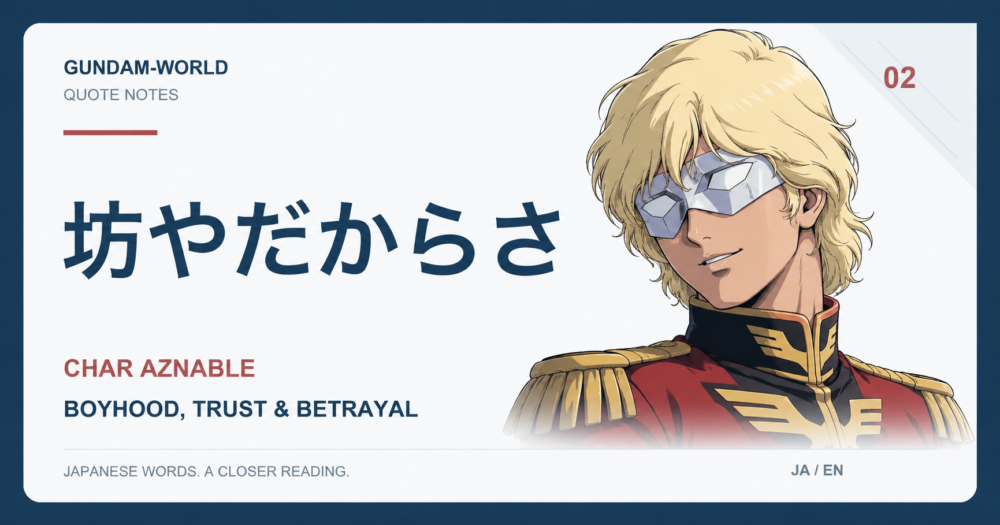
Bouya dakara sa means, literally, “Because he is a boy” in this scene—our rendering of Char Aznable’s dismissive remark about Garma Zabi. Its force is not a statement that Garma is a small child. Char is judging his innocence or immaturity. The line occurs in episode 12 of the original Mobile Suit Gundam television series.
Spoilers: This article discusses Garma’s death and Char’s betrayal. Our English renderings are labelled as our own; a publisher’s English example is identified separately below.
Where does Char say it?
坊やだからさ
Mobile Suit Gundam; Japanese dialogue
Our translation: Because he is still a boy.
The official Gundam Power Word feature places Char’s remark at Garma’s state funeral, which he watches on television. It also explains the contrast between their friendship and Char’s hidden revenge against the Zabi family. He helped bring about Garma’s death, then assesses the trust that left Garma vulnerable.
That separation matters. This is a private comment made while watching a public ceremony, rather than an explanation spoken directly to Garma. We read its chilling effect in the mismatch of scale: a life and a friendship can be reduced, by the person who betrayed them, to an almost casual assessment.
The three parts of “bouya dakara sa”
Bouya is a word for a boy or little boy. Depending on who speaks and how, it can sound affectionate, patronizing or dismissive. Here, reducing Garma to boyhood denies him the worldly understanding Char claims for himself. Translating the word by age alone would miss how it works as a judgment.
Dakara gives a reason: “because.” The short reply has the shape of an explanation that needs no elaboration. Char’s confidence is part of its cruelty. For this reading, the sentence does not invite a discussion of all the pressures and choices that shaped Garma; it closes that discussion before it begins.
The final sa adds a conversational finish. It has no single English word that can be inserted mechanically in every sentence. Here we can hear a relaxed, matter-of-fact edge, although delivery and context do much of the work. Expanding it into an angry accusation would create a different emotional temperature.
Boy, kid or spoiled brat: what changes in English?
A more interpretive translation of our own is “Because he was so naive.” It makes the contextual judgment immediately clear, but loses the image of boyhood. A rendering built around “kid” can keep the sense of speaking down to someone. “Brat” is harsher: it may suggest bad behavior as well as immaturity, so it should not be treated as a neutral dictionary replacement for bouya.
Takarajimasha’s publisher page for its Gundam English-learning book prints the example “Because He was a spoiled brat.” The page describes chapter 1 as using original English translations made by its editorial team. We cite this as a publisher’s educational example; it is not evidence for the wording of a particular TV subtitle or dub.
The added idea of being “spoiled” helps readers imagine privilege or insufficient worldly experience. It is an interpretation made explicit in English, rather than a separate adjective present in the short Japanese line. Comparing versions becomes more rewarding when we ask what they add, instead of declaring one familiar expression the only possible translation.
Does Char’s judgment tell the whole story of Garma?
We should distinguish a memorable character judgment from an impartial account. Char is an involved party with his own purpose. Describing Garma as inexperienced can expose a real vulnerability while also allowing the betrayer to make his own action seem inevitable. That second possibility is our reading of the scene, rather than a fact established by the grammar.
There is an especially sharp contrast with Char’s own reluctance to admit the mistakes of youth. When the youth is his own, the language becomes reflective. When he judges Garma, a few words are enough. Reading the two together lets us ask whether Char applies the same generosity to himself and to others.
Quick questions
Who is the “boy” in this Char quote?
Garma Zabi. In context, the label concerns Char’s view of his immaturity and trusting nature, rather than literally identifying a small child.
Is the funeral remark in the episode where Garma dies?
The quotation discussed here is the funeral-broadcast remark in TV episode 12. Do not collapse the death and the later funeral into one scene.
Is a THE ORIGIN translation interchangeable with the TV line?
No. THE ORIGIN is a separate retelling. A manga translation can be interesting to compare, but should retain its edition label rather than be presented as proof of the original television subtitle.
More Gundam quotes to read closely
Compare these different voices: Full Frontal on mistakes and adulthood, Durandal on conflict and power, and Delaz on a great cause and small matters. Each essay separates the Japanese wording from our interpretation and translation.




Comments