
Setsuna’s “I am Gundam” means that he wants to embody what Gundam represents to him: an intervention that can end the fighting. The line is not a claim that his body is a mobile suit. In Mobile Suit Gundam 00, the distinction between piloting a powerful weapon and living up to that ideal is precisely what makes the statement difficult.
Spoilers: Setsuna’s childhood and the broad development of his outlook in the first season. Translations of the Japanese expressions below are our own; they do not reproduce a specific licensed subtitle track.
俺がガンダムだ
Setsuna F. Seiei · Mobile Suit Gundam 00
Ore ga Gundam da — “I am Gundam.”
Why Gundam means more than a machine to Setsuna
Setsuna’s history as a child soldier is essential. A Gundam’s intervention saves him from a battlefield where the beliefs he had been given no longer provide an answer. The machine becomes tied to an experience of rescue. When he later pilots a Gundam himself, he is attempting to stand on the other side of that encounter: to become the presence that stops another person’s war.
This does not make his ideal simple or automatically correct. Celestial Being tries to eliminate war through armed intervention. Setsuna therefore carries an uncomfortable question inside his declaration: can he use a weapon to bring about the end of weapons being used? Hearing the line as a promise rather than a description makes that contradiction visible.
The official “Gundam Power Word” feature describes the expression as self-encouragement. The official tenth-anniversary poll places it first among its listed 00 lines and discusses Gundam as a symbol of salvation for the young Setsuna. Those features help explain why it became shorthand for Setsuna, rather than evidence that the sentence is intended only as a joke. Power Word feature; anniversary poll.
What does “ore ga” contribute?
Ore is an informal first-person pronoun often associated with masculine speech. It suits Setsuna’s directness. The particle ga marks the subject and, in the right context, can give the declaration a sense of identification: “I am the one.” It should not be mechanically replaced with an English word every time it appears. The whole sentence and situation create the emphasis.
The closing da states the identification plainly. “I am Gundam” preserves the startling shape of that statement. “I embody Gundam’s ideal” is a helpful explanation, but adding it to the quotation would remove the very ambiguity that the story asks the audience to work through. Keeping the short translation, then unpacking it, lets both languages retain their force.
“I am Gundam” and “We are Gundam”
The later shift to oretachi, “we,” widens the subject. The significant change is not that more people can now operate Gundams. It is that the ideal can be carried collectively. Setsuna’s personal experience of rescue is no longer the only centre of the sentence; the others who share the task and its consequences enter the declaration.
One reading is that the change loosens the burden of solitary self-identification. If Gundam names a purpose, another person can participate in it without having the same childhood or temperament. This reading does not erase the first season’s disagreements. It makes their difficult cooperation part of what the word can mean.
Why the meme works—and what it leaves out
Out of context, “I am Gundam” sounds like a person announcing that he is a giant robot. The mismatch makes the sentence instantly repeatable. Within the series, the same mismatch has emotional weight: a human being is trying to become an impossible symbol. The meme and the character reading begin with the same odd wording, but stop at different places.
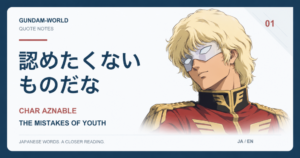
A productive rewatch question is whether Setsuna’s actions deserve the name he gives himself. Does a battle interrupt violence, merely redirect it, or create another grievance? Treating the quote as a standard he struggles to meet keeps him more interesting than treating it as an unquestionable victory slogan. Full Frontal’s words about accepting mistakes offer a useful companion question: how does someone learn and change when an action falls short of the ideal?
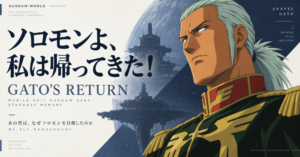
Compare this self-definition with Heero’s “I’ll kill you”, another young soldier’s abrupt declaration. For an older soldier attaching a personal identity to a place and a cause, see Gato’s return to Solomon.
Quick answers
Does Setsuna literally think he is a robot? The line is best understood through Gundam’s symbolic meaning to him. Can “I embody Gundam” replace the translation? It explains one layer, but softens the original’s deliberate strangeness. What changes in “We are Gundam”? The subject becomes collective, opening the ideal beyond Setsuna alone.
References: Mobile Suit Gundam 00, first season; the official Power Word explanation and 2017 quote poll. The discussion of the promise and its contradictions is this article’s interpretation.
Featured image: original AI-generated fan illustration created for Gundam-World.



Comments