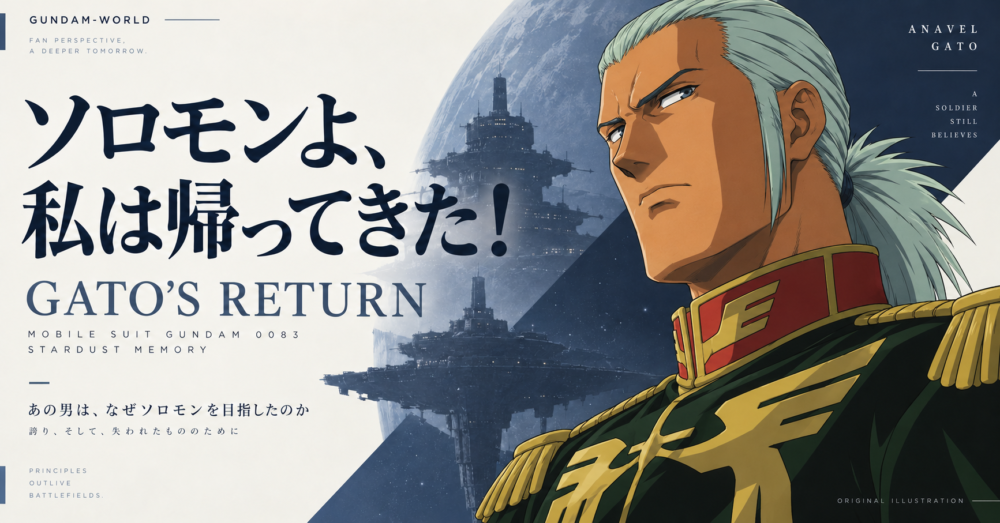
Anavel Gato’s “Solomon, I have returned!” announces his return to a former Zeon fortress, now held by the Federation under the name Konpeitoh. He says it in episode 9 of Mobile Suit Gundam 0083: Stardust Memory, during the attack on the Federation’s naval review. It is a declaration of reclaimed identity as well as a statement about arriving at a place.
Spoilers: Gato’s operation and the nuclear attack in episode 9 of the OVA. The English quote below is our translation of the Japanese, rather than a transcription of a particular licensed release.
ソロモンよ、私は帰ってきた!
Anavel Gato · Mobile Suit Gundam 0083: Stardust Memory
Solomon yo, watashi wa kaette kita! — “Solomon, I have returned!”
Why Solomon, if the fortress is called Konpeitoh?
The choice of name carries the meaning. Konpeitoh is the Federation name for the captured fortress; Solomon is the name bound to its Zeon past. By addressing it as Solomon, Gato speaks through that earlier allegiance. He has reached a physical location, but he also insists on the version of history to which he still belongs.
For a character remembered as the “Nightmare of Solomon,” the name is personal. It connects the veteran he was during the One Year War to the man conducting the new operation. The return is not peaceful homecoming. It is an attempt to answer defeat through an act of force, with the place itself treated almost as a witness.
What happens in episode 9?
Gato uses the stolen Gundam GP02A, carrying a nuclear weapon, to strike the assembled Federation fleet. The official episode guide describes the diversion that allows his approach to Konpeitoh and Kou’s pursuit afterward. The operational context is essential: the famous declaration accompanies an attack with catastrophic consequences, not simply a dramatic entrance. Source: official 0083 story guide, episode 9.
A viewer can find the delivery powerful while remaining disturbed by what it announces. That double response is a strength of the scene. Gato’s composure and conviction make his self-image clear, but the destructive result prevents the line from becoming an uncomplicated statement of courage. His cause explains his motivation; it does not erase the people caught in its execution.
How the Japanese makes the place an audience
The particle yo after Solomon is a direct address: he calls out to the place. It is different from merely saying that he has arrived at Solomon. English can convey this with the comma in “Solomon, I have returned!” The fortress becomes the listener to whom the return is announced.
Watashi gives the declaration a relatively formal first-person expression. It does not have the youthful roughness associated with ore. Kaette kita describes coming back, with kita orienting the movement towards the point of return. The sentence lets the audience hear both the arrival and the significance Gato assigns to it.
“I’m back!” is a possible concise rendering, but sounds more conversational in isolation. “I have returned!” gives English a more ceremonial register. Neither wording carries all the history on its own. The location’s two names, Gato’s reputation and the action surrounding the line supply the emotional weight.
Pride, loyalty and the limits of a “great cause”
Gato is compelling partly because he appears to know exactly who he is. He does not need to invent an identity at the moment of return. Yet certainty can become a closed circle: loyalty to the past defines the next act, and the next act seems to prove the loyalty. The scene invites us to notice the costs that fall outside that circle. Compare Char’s reluctance to acknowledge youthful mistakes: both speakers frame a difficult past, but Gato announces an answer through action rather than admitting a failure.
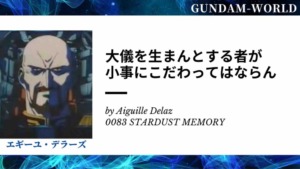
This is a useful companion to Delaz’s words about a great cause and small matters. Delaz provides a language of purpose; Gato gives that purpose a voice and a weapon at Solomon. Reading the two together clarifies the attraction of their convictions and the danger of letting conviction settle every moral question.
The same battlefield name produces a very different tone in Sleggar’s “Sad, but this is war”, set during the original series’ Battle of Solomon. Where Gato announces his return to history, Sleggar acknowledges what the immediate battle is taking from him. The contrast rewards reading both lines in context.
Quick answers
Which episode is the quote from? OVA episode 9, “The Nightmare of Solomon.” Why does he use the old name? It expresses his continuing Zeon allegiance and makes the return personal. Is the scene a harmless victory speech? No: it accompanies the GP02A’s nuclear strike on the naval review, which is central to its meaning.
References: Mobile Suit Gundam 0083: Stardust Memory, episode 9; official story guide and official series introduction. The reading of naming, pride and loyalty is this article’s interpretation.
Featured image: original AI-generated fan illustration created for Gundam-World.




Comments