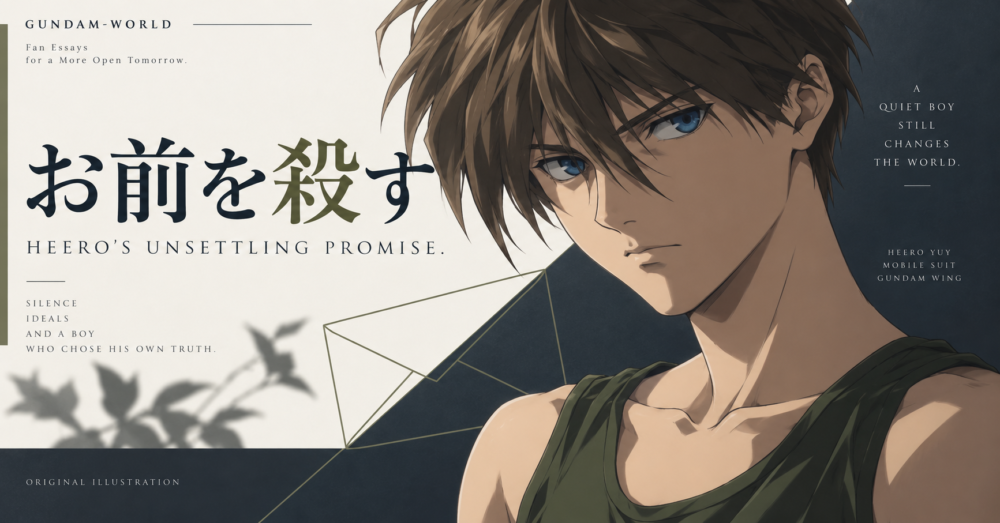
“Omae wo korosu” (お前を殺す) means “I’ll kill you.” Heero Yuy says it to Relena at the end of episode 1 of Mobile Suit Gundam Wing. The notorious moment is a threat from a boy protecting his identity, delivered where a normal school introduction might have been expected. That collision makes it memorable before any meme enters the picture.
Spoilers: the closing scene of episode 1 and the premise of Heero and Relena’s relationship. English renderings below are this site’s translations of the Japanese, rather than a transcription of a particular dub or subtitle release.
お前を殺す
Heero Yuy · Mobile Suit Gundam Wing, episode 1
Omae wo korosu — “I’ll kill you.”
What happens when Heero threatens Relena?
Relena attempts to bring Heero into an ordinary social exchange by inviting him to her birthday party. His response destroys that expectation: he tears up the invitation, wipes away her tears and makes the threat. The tenderness of one gesture and the violence of the next do not settle into a comfortable emotional sequence. Relena is left trying to understand what kind of person she has encountered.
Heero is involved in a secret military operation. For him, being recognised brings consequences that his new classmates cannot see. This explains the threat’s immediate context; it does not turn his behaviour into normal conversation. The scene introduces a young person whose training has pushed mission requirements ahead of the social habits that would usually make him approachable.
Why “Deden” became attached to the quote
“Deden” is a fan spelling of the emphatic musical sting associated with the moment. It is not an extra word spoken by Heero. Searching for the quote together with デデン can therefore lead to discussion of the scene’s timing, exaggerated impact and later parodies, rather than a different line of dialogue.
The joke is easy to recognise even without knowing the larger plot: a birthday invitation receives a death threat, then the sound underlines the shock. At a 30th-anniversary event, the official Gundam report also discussed the phrase as a route through which viewers found the first episode on YouTube. That is evidence of the scene’s cultural reach, rather than a measure of current Google search volume. Source: official anniversary event report.
What the Japanese adds to “I’ll kill you”
Omae is a direct way of saying “you.” It can have different shades between people who know one another, but in this confrontation it gives Heero’s address a blunt edge. Korosu is the plain form of “kill.” There is no polite ending, request or cushion around it. The Japanese also omits an explicit “I”; the speaker and intended action are obvious from the situation.
Japanese does not need a separate future-tense form here. English naturally supplies “will,” usually contracted to “I’ll,” to make the threat readable. “I kill you” can illustrate the components, but sounds less natural as a stand-alone future threat. An actor using that wording at an event would not, by itself, establish the wording of a licensed English dub.
The plain wording matters more than adding exclamation marks. Heero’s menace comes partly from presenting the statement without the emotional explanation that Relena, and the audience, would expect. A loud English delivery and a quiet one can communicate very different versions of the same sentence.
Is it a strange confession of love?
At this point in episode 1, calling the threat a romantic confession skips the problem that makes it interesting. Relena is curious about Heero; Heero attempts to shut down contact. Their later relationship gives the opening new associations, but it should not replace the immediate context. The enduring tension is between a boy trying to act like a weapon and a person who continues to address him as a human being.
That makes a useful comparison with Setsuna’s “I am Gundam”: both lines sound extraordinary when detached from the young soldier who speaks them. For another example of a short sentence whose tone depends on its setting, read Char’s “Bouya dakara sa”.
Quick answers
Which episode is it from? Episode 1 of Gundam Wing, in the closing school scene with Relena. Is “Deden” part of the Japanese sentence? No: it refers to the musical punctuation. Is the English above an official subtitle? It is our translation for explaining the Japanese; release-specific dialogue needs to be checked against that release.
References: Mobile Suit Gundam Wing, episode 1; the official cast-event report. Interpretation of the gestures and wording is this article’s reading of the scene.
Featured image: original AI-generated fan illustration created for Gundam-World.
Comments